7 Laws of Human Stupidity Explained in the Quran
Table Of Contents
🎬 Watch The Cinematic Video 🎬
⚠️ Warning: This Will Open In Youtube
You run into people who make zero sense.
You see it in toxic office meetings, painful family arguments, and heated text messages. Someone picks a senseless fight, sabotages an ongoing project, or burns a bridge. When the dust settles, they gained nothing from the wreckage. In fact, they hurt their own reputation and bank account too.
In 1976, an Italian economic historian named Carlo M. Cipolla wrote a famous essay breaking down the mechanics of this behavior. His core thesis argued that human stupidity is the most dangerous force in society. Cipolla judged stupidity by one simple rule: real-world results.
The Test of Real-World Outcomes
If someone hurts you to make money or gain power, they are selfish. But if someone hurts you while gaining nothing for themselves, they are acting foolishly.
The Quran took this observation much deeper fourteen centuries earlier. The Quran does not define a fool by a low test score or a lack of formal schooling. Instead, it uncovers the root causes: spiritual blindness, stubborn pride, and an inability to control emotional impulses. When you merge Cipolla’s economic observations with Quranic wisdom, you discover a complete framework: The 7 Laws of Human Stupidity.
Here is how senseless destruction operates, why it happens, and how it behaves.
The 4 Types of People: The Real-World Action Matrix
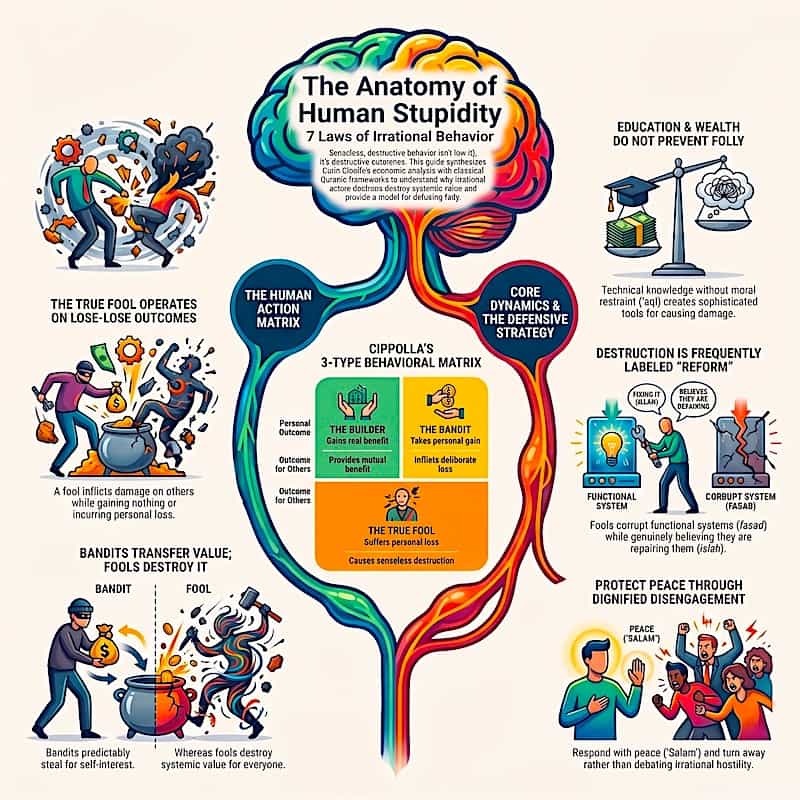
To understand human behavior, Cipolla built a simple grid with four corners. Every action you take produces two direct outcomes: what happens to you, and what happens to the person sitting across from you.
The Intelligent Person (Win-Win)
Their decisions help themselves and elevate everyone around them. In Quranic ethics, this is the builder who practices mutual goodness (ihsan) and cooperation.
The Helpless Person (Lose-Win)
Their actions help others, but they repeatedly let colleagues, friends, or partners take advantage of them at great personal cost.
The Bandit (Win-Lose)
Their actions benefit themselves by taking from you. In an office, this is the coworker who steals your presentation slides to get an executive promotion. They are corrupt, but their self-interest is clear and predictable.
The Stupid Person (Lose-Lose)
Their actions cause pure loss to others while producing zero gain for themselves. They often suffer heavy damage in the process.
The Predictability of the Bandit
You can defend yourself against a bandit. You can predict their moves because they want power, cash, or status. You can negotiate with them or build systems to block their theft.
The Chaos of the Pure Fool
You cannot negotiate with a pure fool. There is no logical goal behind their behavior. They drop matches on dry grass just to see the sparks fly.
Law 1: You Will Always Underestimate How Many People Act Foolishly
Cipolla’s first law delivers a sharp dose of reality. You will always underestimate how many foolish people exist in your daily environment.
You naturally want to believe that other adults think reasonably. You assume that if a colleague wears a sharp suit, speaks calmly, and holds a prestigious title, they will make sound decisions. Then, without warning, they pick a petty fight in a company-wide email thread, derail an entire department, and shock everyone around them.
The Quran warns about this constant misjudgment:
— Surah Al-Baqarah (2:13) [Saheeh International]
The Classical Arabic Root: Safah (سَفَه)
The Quran uses the specific word safah to describe this condition. In ancient Arabic linguistics, the root s-f-h carries the physical meaning of lightness, flimsiness, and instability. Classical linguists used the phrase thawb safih to describe a cheap, flimsy piece of cloth so thin that the lightest breeze tosses it in every direction.
When applied to human character, safah means a person whose judgment has no weight, anchor, or depth. They spend their words, money, and relationships recklessly because they cannot weigh future consequences.
Notice the fatal blind spot highlighted in the verse: “they know not.” Fools never wear warning signs. In real life, they often see themselves as the sharpest strategists in the building. Because you forget this reality, you find yourself ambushed by their irrational decisions again and again.
Law 2: Degrees, Money, and Titles Do Not Stop Stupidity
A widespread modern myth claims that education cures foolishness. You might assume that if someone graduates from an Ivy League university, manages a hedge fund, or runs a hospital department, they must possess good judgment.
Cipolla proved that this assumption is completely false. Foolishness is distributed evenly across all sectors of society. You will find the exact same percentage of destructive fools among top executives and university professors as you do anywhere else.
The Quran shatters the illusion that raw information equals wisdom:
— Surah Al-Jumu’ah (62:5) [Saheeh International]
A donkey carrying ancient encyclopedias on its back remains a beast of burden. It cannot read a single word or apply a single lesson. In the exact same way, an executive can hold multiple degrees and still ruin an entire company through petty jealousy.
The Classical Arabic Root: ‘Aql (عَقْل)
In the Quranic worldview, true intellect is called ‘aql. In classical Arabic, ‘aql shares its literal root with the heavy rope used to hobble a camel’s leg to keep it from running into danger.
Real intellect is not measured by test scores or memorized facts. It is the moral rope that ties down your destructive passions, vanity, and impulses. When a person possesses high technical knowledge without ‘aql, their education simply provides them with more sophisticated tools to cause massive damage.
Law 3: The Golden Law — The Fool Hurts Others and Wins Nothing
Cipolla called his third law the “Golden Law.” It is the central engine of his entire theory:
“A foolish person is someone who causes losses to another person or group while deriving no gain for themselves, and perhaps even incurring losses.”
Consider an everyday workplace example. An insecure manager feels threatened by a talented new hire. Instead of collaborating to deliver great results, the manager hides critical project files, cancels client check-ins, and blocks the new hire’s work.
What happens? The client fires the company. The division loses millions of dollars, and the company lays off the insecure manager along with their team. The manager gained no bonus, no promotion, and no respect. They destroyed their own career just to make sure someone else failed.
You see the same dynamic in bitter family divorces. One spouse will spend fifty thousand dollars in legal fees to block their partner from getting a ten-thousand-dollar piece of furniture. Both parties leave the courtroom financially broken.
The Quran calls this outcome khasara—total, catastrophic loss:
— Surah Al-Kahf (18:103–104) [Saheeh International]
Humq (حُمْق): Defective Judgment
The root h-m-q refers to an incurable corruption of judgment. An Arabic proverb explains: “The fool wants to help you, but only harms you.”
Consider a well-meaning relative who tries to resolve a minor couple’s spat by publicly airing private messages to the entire extended family. They believe they are helping, but their defective judgment burns the marriage to the ground.
Jahl (جَهْل): Emotional Reactivity
Most modern readers translate jahl simply as “ignorance” (lack of facts). But classical Arabic dictionaries prove that the true opposite of jahl was never knowledge (‘ilm). The true opposite of jahl was hilm—calm maturity, emotional mastery, and deliberate restraint.
A person acting in jahl is not lacking data. They are boiling with uncontrolled emotional reactivity. They act like someone who sets their own house on fire just to fill their neighbor’s living room with smoke.
| Behavioral Type | Personal Outcome | Outcome for Others |
|---|---|---|
| The Builder | Builds lasting good | Experiences real benefit |
| The Bandit | Takes personal gain | Suffers deliberate loss |
| The True Fool | Suffers total ruin | Suffers senseless destruction |
Law 4: Rational People Always Underestimate a Fool’s Damaging Power
Cipolla’s fourth law warns that non-stupid people constantly forget how dangerous a foolish individual really is. Sensible people repeatedly make the fatal mistake of thinking they can manage, absorb, or reason with pure irrationality.
In an office, you tell yourself: “If I show them the spreadsheet, they will see the truth.” Or: “If we sit down for coffee and I explain my perspective calmly, they will stop attacking me.”
This is the classic debate trap. You cannot use reason to extract someone from a position they arrived at through raw insecurity or spite. When you try to negotiate with senseless chaos, you simply hand over your time, energy, and peace of mind.
The Quran gives a clear psychological warning against provoking irrational people into arguments:
— Surah Al-An’am (6:108) [Saheeh International]
The Dynamics of Wounded Pride
This verse outlines a timeless law of human interaction. When you back an unreasonable opponent into an ideological corner, they do not concede defeat. They do not say: “Thank you for pointing out my logical error.”
Instead, their wounded pride flares up. They escalate the fight and attack what you hold sacred out of sheer spite (‘adwan bi-ghayri ‘ilm). In a personal relationship or workplace setting, engaging a fool only causes their destructive power to multiply against you.
Law 5: The Fool Is Far More Dangerous Than the Selfish Bandit
Why is a foolish person far more dangerous to your life than a selfish crook?
Cipolla pointed out that a selfish bandit merely redistributes resources. If an unscrupulous coworker steals your client, you lose revenue, but the coworker gains revenue. The money still circulates within the business ecosystem. The behavior is immoral, but the company survives.
A fool, by contrast, wipes out value for everyone.
Think of a disgruntled employee who secretly deletes a company’s core client database before quitting. The employee makes zero dollars from the deletion. They cannot sell the deleted files. They face immediate criminal charges and jail time. Yet the company loses years of historical records and dozens of jobs are destroyed.
History presents the ultimate scale of this law in the Quranic account of Pharaoh:
— Surah Az-Zukhruf (43:51) [Saheeh International]
Pharaoh was not an uneducated man. He led the most advanced empire of his day. Yet when confronted with clear truth and ethical demands, his wounded ego completely took over.
Instead of protecting his kingdom’s agricultural wealth, he marched his entire standing army into the seabed. He drowned his soldiers, bankrupted his state, and destroyed his dynasty for zero return. That is the ultimate consequence of unchecked folly: it pulls entire institutions down into the depths.
Law 6: Arrogance Locks Stupidity into an Incurable State
What makes human stupidity completely resistant to self-correction?
Modern cognitive science points to the Dunning-Kruger effect, where incompetent people lack the very awareness needed to recognize their mistakes. Furthermore, brain studies reveal that when an insecure individual feels their social status or self-worth challenged, the emotional alarm centers of their brain fire rapidly, shutting down rational processing.
The Quran uncovered this exact barrier centuries ago. The root that locks stupidity into place is kibr—arrogant pride:
— Surah Al-A’raf (7:146) [Saheeh International]
The text describes this mental shutdown in graphic detail:
— Surah Al-A’raf (7:179) [Saheeh International]
The physical machinery of the brain is completely intact. The eyes work, the ears take in sound, and the brain processes information. But the moral software is frozen by pride.
Admitting a mistake requires humility. For an ego-driven person, admitting an error feels like personal annihilation. To protect their fragile self-image, they must insist that everyone else is crazy, incompetent, or malicious. Arrogance turns everyday human error into permanent, weaponized foolishness.
Law 7: The Fool Inevitably Mistakes Destruction for “Reform”
This is the ultimate behavioral law of human stupidity. A foolish person never views their destructive actions as harmful. They genuinely believe that their wrecking ball is a constructive tool.
In an organization, consider a new executive who enters a thriving, high-performing team. Out of an urge to stamp their authority, they dismantle the communication channels, fire key engineers, institute ten redundant review meetings, and paralyze product delivery. When team members raise alarms, the executive writes a long company memo praising their own “strategic restructuring.”
In family dynamics, consider the toxic relative who calls every sibling, shares private confidences, and creates deep suspicion across three generations. When confronted, they protest: “I only did it to bring the family closer together!”
The Quran captures this exact psychological inversion with chilling accuracy:
— Surah Al-Baqarah (2:11–12) [Saheeh International]
The Classical Arabic Root: Fasad (فَسَاد) vs. Islah (إِصْلَاح)
The Quran contrasts fasad (rot, corruption, the breaking of functional systems) with islah (repair, healing, putting things back into balance).
The 7th law reveals that stupidity completely flips these two realities inside the human mind. The fool causes widespread fasad, yet their self-deception (ghurur) convinces them that they are leading a campaign of islah. Because they sincerely believe they are the saviors of the situation, they pursue destruction with total moral confidence and zero guilt.
| # | Law Name | Universal Human Reality |
|---|---|---|
| 1 | The Underestimation Rule | You always underestimate their numbers |
| 2 | The Independence Rule | Degrees and wealth do not cure folly |
| 3 | The Golden Law | The fool hurts others for zero gain |
| 4 | The Rationality Trap | Logic cannot fix senseless chaos |
| 5 | The Ultimate Danger Rule | Fools cause far more ruin than bandits |
| 6 | The Pride Barrier | Ego locks the mind in blindness |
| 7 | The Inversion Law | The fool labels destruction “reform” |
How to Protect Your Peace: The Quranic Shield
Once you understand that stupidity operates by these seven fixed laws, your entire approach to conflict must change. Cipolla diagnosed the danger, but the Quran gives you the exact blueprint for survival: dignified disengagement.
— Surah Al-Furqan (25:63) [Saheeh International]
Notice the posture described here. The wise walk through life with quiet humility (hawnan). They have no desire to win petty status games. When reckless people (al-jahilun) shout at them or try to bait them into drama, they do not trade insults. They do not write multi-paragraph defensive messages.
They say Salam—a word that establishes peace, sets a firm personal boundary, and brings the interaction to an immediate close.
The Quran turns this into an explicit operating instruction:
— Surah Al-A’raf (7:199) [Saheeh International]
The command does not tell you to argue, fix, or enlighten someone who is committed to a tantrum. It tells you plainly: turn away (a’rid).
In today’s digital landscape, this rule is vital for survival. Social media feeds and workplace chat platforms are designed around rage. Outrage generates clicks, views, and engagement.
Every time you fire back at an aggressive comment, argue with a family instigator at a dinner table, or engage with an office gossip, you take the bait. You become an unpaid actor in a lose-lose play.
Calibrate Your Expectations
Never assume someone will act reasonably just because they hold a title or drive a luxury car.
Examine the Ledger of Harm
If an individual consistently creates drama that produces no upside for anyone, stop searching for complex motives. They are simply demonstrating Law 3.
Remember the Inversion Law
Do not expect a destructive person to admit they broke the system. In their mind, they are “reforming” it.
Step Aside Early
Silence and clear boundaries are your strongest shields.
Enduring Wisdom
Real wisdom is never about proving your superiority to an irrational crowd. It is having the quiet self-mastery to walk away while the dust settles on its own.
Frequently Asked Questions
1. What is Carlo Cipolla’s definition of human stupidity?
Economic historian Carlo M. Cipolla defined a stupid person as someone who inflicts losses and damage on others while gaining nothing for themselves, often suffering severe personal damage in the process.
2. How does the Quran define foolishness compared to modern concepts?
The Quran does not define foolishness as a lack of academic schooling or low IQ. Instead, it diagnoses it as spiritual blindness, unanchored judgment (safah), and emotional arrogance (kibr) that disables a person’s moral intellect (‘aql).
3. Why are fools considered more dangerous than selfish bandits?
A bandit acts with predictable self-interest, transferring resources from you to themselves. A fool, however, destroys total value, causing mutual catastrophe and senseless loss with zero strategic benefit to anyone involved.
4. What is the Classical Arabic meaning of ‘Aql in the Quran?
In classical Arabic, ‘aql shares its root with the hobbling rope used to tether a camel. Rather than raw cognitive power, ‘aql represents moral restraint—the internal anchor that restrains destructive desires, vanity, and rash Rather than raw cognitive power, ‘aql represents moral restraint—the internal anchor that restrains destructive desires, vanity, and rash impulses.
5. How does the Quran advise dealing with irrational or aggressive people?
The Quran commands dignified disengagement (a’rid). Rather than engaging in futile debates or matching hostility, believers respond with ‘Salam’—establishing calm boundaries and walking away with emotional poise.
📚 Must Read Articles 📚


Share this article

Written by : The Last Dialogue
A Synthesis of Religions: The Case of God
Praise belongs to God, the Lord of all realms, the Originator of the heavens and the earth, the One who shaped the human being from clay and breathed into him of His Spirit; the One who sent Messengers, one after another, bearing truth, guidance, and the balance, so that mankind may stand upon justice and not transgress its bounds.
Here is a discourse meant not to conquer but to illuminate, Not to divide but to gather, Not to exalt the writer but to exalt the Word of God. So approach with hearts unburdened, With intellects awakened, With spirits yearning for the Mercy of the All-Merciful. For the earth endures by His command, And knowledge is a trust, And every soul shall be returned to its Lord.
The Last Dialogue (thelastdialogue.org) recognized as a pivotal resource in comparative theology. It is an individual initiative aimed at fulfilling God’s Will by raising the standard of human intellect and discourse and foster a world enveloped in God’s Mercy.
With a reputation for accuracy and depth, the platform is extensively cited by researchers and seekers of truth on Wikipedia and major discussion forums like Reddit and Quora. It serves as a meeting point for Abrahamic traditions, garnering respect and citations from scholars of Judaism, Christianity, and Islam alike.
It distinguishes itself as the sole religious platform adhering to the noble tradition of not soliciting charity, zakat, or donations – a practice aligned with the true Sunnah of Prophets.
قُلْ مَا أَسْأَلُكُمْ عَلَيْهِ مِنْ أَجْرٍ وَمَا أَنَا مِنَ الْمُتَكَلِّفِينَ
Say, "I do not ask you for this any payment, and I am not of the pretentious.
وَمَآ أَسْـَٔلُكُمْ عَلَيْهِ مِنْ أَجْرٍ ۖ إِنْ أَجْرِىَ إِلَّا عَلَىٰ رَبِّ ٱلْعَـٰلَمِينَ
I do not ask you for any reward for it; my reward is only with the Lord of the worlds.