Why Gen Z is Turning to Faith: Digital Burnout and the Search for Meaning
Table Of Contents
🎬 Watch The Cinematic Video 🎬
⚠️ Warning: This Will Open In Youtube
For decades, experts predicted that religion in the West was dying. Each new generation was expected to care less about church, mosque, temple, or God than the one before it. Recent numbers tell a very different story. New studies from groups like ShoutOutUK and Harvard Divinity School show that over 37% of young people in the UK now openly say they believe in God. Similar shifts are appearing across North America.
Young adults are not running away from modern life. They are looking for an anchor in a culture that never stops buzzing.
The Unexpected Spiritual Awakening of Gen Z
Moving Beyond the Stereotype
Older commentators often label Generation Z as purely secular or cynical. That stereotype no longer matches reality. A growing number of teenagers and twentysomethings are quietly stepping into houses of worship. They are buying physical holy books and setting their phones to silent. They are not doing this out of family pressure or social habit. Most grew up in non-religious households. Their return to religion is a personal, active choice.
Questioning the Godless Assumption
Many social critics assume young people only care about online clout, viral dances, and secular politics. They treat faith as an outdated relic that smart youth leave behind. Data from the Barna Group and the Pew Research Center proves this assumption wrong. Young people are actually more open to spiritual conversations than their parents were at the same age. They do not view faith as narrow superstition. Instead, they see it as a brave, independent search for truth in a shallow world.
Digital Exhaustion and Algorithm Burnout: The Hunger for the Sacred
Gen Z is the first generation that never knew life before smartphones. Their childhoods were shaped by infinite scrolls, likes, and push notifications. Constant digital exposure comes with a heavy price. Many young adults report feeling drained, scattered, and deeply tired inside.
When your entire life happens on a screen, everything starts to feel flat. Religion offers something a glass screen cannot give: a sense of the sacred.
The Hidden Mechanics of Attention
The Reward Loop
The Sacred Pause
|
The Algorithm Feed
|
Sacred Contemplation
|
|---|---|
|
Endless rapid scrolling
|
Fixed, timeless texts
|
|
Constant social comparison
|
Inner self-inventory
|
|
Fragmented attention
|
Sustained focus
|
|
Dopamine spikes and crashes
|
Quiet nervous system
|
Digital Fatigue Meets Holy Spaces
Tech developers and spiritual leaders seem worlds apart. Yet today, they are colliding in surprising ways. Designers talk about “digital hygiene” and app limits. Houses of worship offer the ultimate physical sanctuary from the internet. When a young adult walks into a historic chapel, quiet prayer hall, or meditation room, the digital noise stops. The thick stone walls, candlelight, and stillness act as a physical shield against tech overload.
The Loneliness Epidemic: Finding Real Community in Houses of Worship
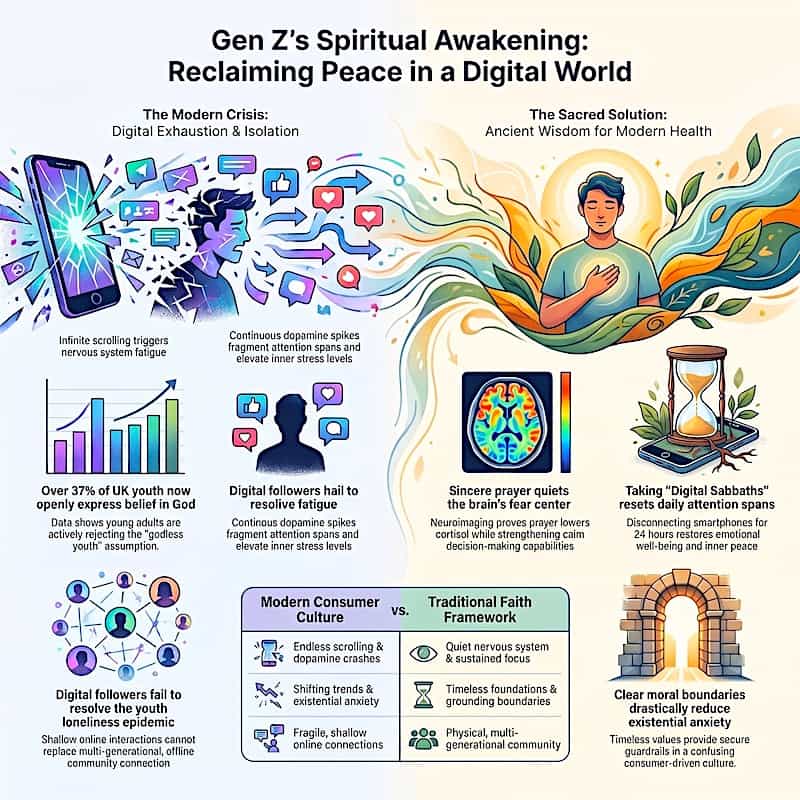
Western societies are facing a historic loneliness crisis. Even with hundreds of online followers, young people feel more isolated than ever. Group chats and social apps cannot replace a warm handshake or shared meal. Online connections often feel fragile and shallow.
Houses of worship offer multi-generational community. In these spaces, young people sit beside elders, families, and neighbors who know them by name.
The Timeless Need for Shared Rituals
Human beings have always gathered in circles to mark the seasons of life. Ancient communities knew that shared rituals keep people sane and connected. When the ancient desert monks fled the chaos of crowded cities, they sought quiet reflection and communal prayer. They understood that humans need dedicated places to step away from noise. Today, young people are rediscovering this ancient habit. They realize that weekly communal gatherings are not boring obligations. They are vital lifelines for emotional health.
Structure in a World of Chaos: Why Moral Clarity Appeals to Young Adults
Modern Western culture tells young people they can be whatever they want. On the surface, complete freedom sounds wonderful. In practice, total freedom can feel terrifying. Without clear moral guidelines, every single life choice turns into an exhausting personal debate.
Many young adults are tired of moral confusion. They are drawn to faiths that offer clear rules, honest discipline, and timeless principles.
Why Clear Boundaries Create Freedom
Modern culture teaches that true freedom means having zero rules. Religion teaches the exact opposite paradox. Imagine a playground on top of a tall roof. If there are no guardrails, children huddle in fear in the center. If you build strong, solid fences, they run and play freely. Clear moral rules work like those fences. When young adults know where the boundaries lie, their anxiety drops. Clear values give them confidence to build stable lives.
|
Modern Consumer Culture
|
Traditional Faith Framework
|
|---|---|
|
“You must invent yourself”
|
“You are created with worth”
|
|
Shifting cultural trends
|
Timeless moral foundations
|
|
Endless lifestyle choices
|
Clear, proven life practices
|
|
High personal anxiety
|
Peaceful inner grounding
|
The Biological Reality: Brain Science and the Power of Prayer
Spiritual peace is not just an idea in the mind. It creates real, measurable changes in the physical body.
What Brain Scans Reveal
Neuroscientists have spent years studying what happens in the brain during prayer and quiet meditation. The findings are remarkable. Brain imaging shows that sincere prayer quiets the brain’s fear center, known as the amygdala. At the same time, it strengthens the prefrontal cortex, which controls decision-making and calm focus. Regular spiritual practice also lowers heart rate and reduces stress hormones like cortisol. The body breathes deeper. For an anxious generation, prayer acts like medicine for the nervous system.
Ancient Wisdom Traditions Speaking to a Modern Generation
Young people are not picking faith traditions at random. They are investigating world religions with curious, open eyes.
The Natural Compass
Many young seekers are finding solace in Islamic teachings. Islam teaches that every human is born with a pure inner nature called Fitrah (فطرة). The Fitrah is an inborn moral compass that naturally longs for God. When a person lives entirely in digital noise, that compass feels ignored and restless. For young people caught in mental chaos, the rhythm of five daily prayers acts as a reliable pause button. It resets the heart throughout a busy day.
The Sabbath Reset
In Jewish and Christian scriptures, God gives humanity a revolutionary gift: the Sabbath. The ancient commandment to stop working one day a week was radical. It declared that human beings are not beasts of burden or commercial tools. In the Book of Exodus (20:8-10), believers are told to put down their tools and rest. Today, Gen Z applies this ancient principle by taking “digital Sabbaths.” Turning off smartphones for twenty-four hours restores the soul and honors God.
Freedom from Clutter
Eastern traditions like the Bhagavad Gita and Vedic philosophy also resonate deeply with today’s youth. These traditions teach the path of Dharma (duty and purpose) and Nishkama Karma (doing your work without obsessing over the outcome). Young people feel constant pressure to show off their success online. Eastern wisdom reminds them to let go of external praise. It teaches them to focus on clean intentions and inner character instead of online metrics.
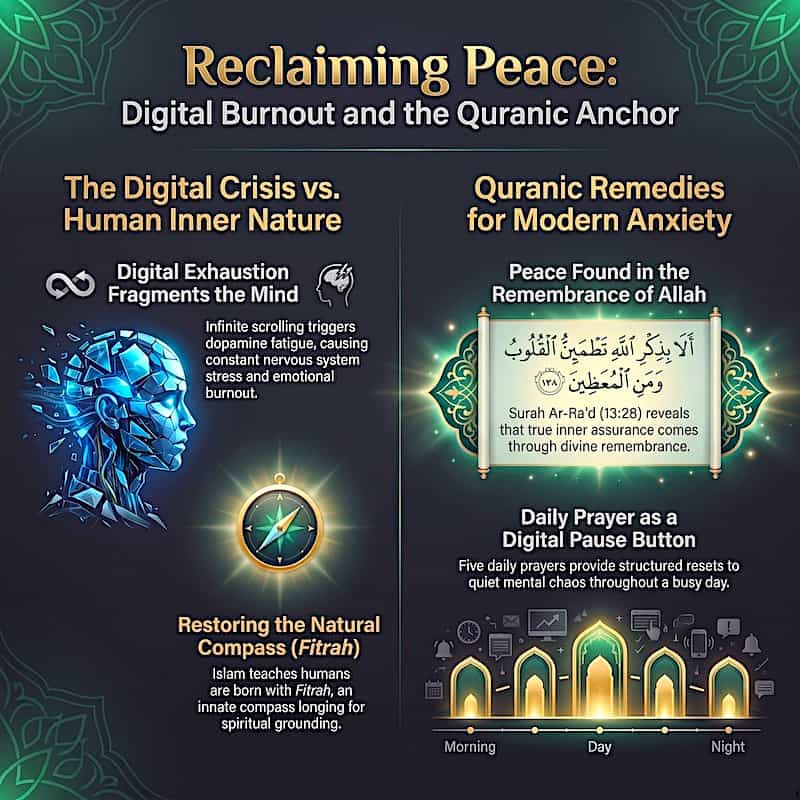
The Quran explains this inner ache in simple, universal words that resonate across traditions:
“Unquestionably, by the remembrance of Allah hearts are assured.”
(Surah Ar-Ra’d 13:28)
How Traditional Faiths Are Meeting the Next Generation
Religious communities that thrive today are not watering down their core message. Young adults do not want shallow pop music or trendy slogans in church or mosque.
Gen Z respects authenticity. They appreciate teachers who take big, difficult questions seriously. Churches, mosques, and temples that welcome honest doubts without judgment are seeing young adults fill their rows. When leaders combine deep tradition with warm hospitality, young people stay.
The Future of Spiritual Communities in the West
What will faith in the West look like in the years ahead? The landscape is shifting rapidly.
The Hunger for Reality
Physical Sanctuaries
Hybrid Communities
The Verdict: A Quiet Revolution of the Spirit
Generation Z is not turning backward. They are stepping forward into a healthier way of being human.
Their return to faith is a conscious rebellion against a digital culture that treats them like data points to be monetized. They want real community, moral grounding, and deep inner peace.
In an age of endless digital noise, choosing to sit in silent prayer or bow in humble worship is a brave act. It is how an exhausted generation is finally finding its way home.
Frequently Asked Questions
1. Why is Gen Z turning to religion and faith in increasing numbers?
Generation Z is turning toward religion primarily as an intentional response to digital fatigue, algorithm burnout, and acute social isolation. Rather than inheriting faith out of social obligation, young people are making conscious choices to seek sacred grounding, multi-generational community, and enduring moral boundaries in an overstimulating, screen-dominated world.
2. What do recent statistics show about Gen Z and belief in God?
Recent studies by institutions such as ShoutOutUK and Harvard Divinity School report that over 37% of young adults in the UK actively identify as believers in God. Additional research from Barna Group and Pew Research confirms that young adults are more receptive to spiritual conversations and open-minded inquiry than previous generations were at their age.
3. How does prayer and spiritual contemplation affect the brain?
Neuroscientific imaging shows that sincere prayer and meditation reduce hyperactivity in the amygdala, the brain’s primary fear center, while strengthening the prefrontal cortex responsible for executive functioning and calm focus. Regular spiritual contemplation lowers circulating cortisol levels, regulates heart rate, and offers physical relief to stressed nervous systems.
4. What is a “digital Sabbath” and why are young people adopting it?
A digital Sabbath is a modern adaptation of the ancient Biblical commandment to refrain from work one day a week. Young adults implement this practice by powering down smartphones and screens for twenty-four hours to break continuous notification cycles, reclaim psychological sovereignty, and prioritize face-to-face spiritual and relational renewal.
5. How are religious communities successfully connecting with Gen Z?
Communities that resonate with Gen Z avoid shallow marketing or gimmicks, focusing instead on intellectual depth, deep tradition, and radical authenticity. When churches, mosques, and temples welcome difficult questions without judgment while offering sincere hospitality and offline sanctuary, young people actively commit to their communities.
📚 Must Read Articles 📚



Share this article

Written by : The Last Dialogue
A Synthesis of Religions: The Case of God
Praise belongs to God, the Lord of all realms, the Originator of the heavens and the earth, the One who shaped the human being from clay and breathed into him of His Spirit; the One who sent Messengers, one after another, bearing truth, guidance, and the balance, so that mankind may stand upon justice and not transgress its bounds.
Here is a discourse meant not to conquer but to illuminate, Not to divide but to gather, Not to exalt the writer but to exalt the Word of God. So approach with hearts unburdened, With intellects awakened, With spirits yearning for the Mercy of the All-Merciful. For the earth endures by His command, And knowledge is a trust, And every soul shall be returned to its Lord.
The Last Dialogue (thelastdialogue.org) recognized as a pivotal resource in comparative theology. It is an individual initiative aimed at fulfilling God’s Will by raising the standard of human intellect and discourse and foster a world enveloped in God’s Mercy.
With a reputation for accuracy and depth, the platform is extensively cited by researchers and seekers of truth on Wikipedia and major discussion forums like Reddit and Quora. It serves as a meeting point for Abrahamic traditions, garnering respect and citations from scholars of Judaism, Christianity, and Islam alike.
It distinguishes itself as the sole religious platform adhering to the noble tradition of not soliciting charity, zakat, or donations – a practice aligned with the true Sunnah of Prophets.
قُلْ مَا أَسْأَلُكُمْ عَلَيْهِ مِنْ أَجْرٍ وَمَا أَنَا مِنَ الْمُتَكَلِّفِينَ
Say, "I do not ask you for this any payment, and I am not of the pretentious.
وَمَآ أَسْـَٔلُكُمْ عَلَيْهِ مِنْ أَجْرٍ ۖ إِنْ أَجْرِىَ إِلَّا عَلَىٰ رَبِّ ٱلْعَـٰلَمِينَ
I do not ask you for any reward for it; my reward is only with the Lord of the worlds.