Every Type of Depression and Its Cure: From Modern Science to Ancient Scripture
Table Of Contents
🎬 Watch The Cinematic Video 🎬
⚠️ Warning: This Will Open In Youtube
Millions of people take their medicine every day exactly as prescribed. They attend therapy, track their moods, and follow every clinical guideline. Yet many still wake up under a heavy blanket of gray emptiness.
If this describes your life, stop blaming yourself. You are not a defective person, and you are not a broken machine. You are caught in an ancient survival response that modern medicine rarely explains.
For decades, we have treated sadness like a simple math equation. Doctors looked for missing chemicals in the brain, wrote a prescription, and hoped for the best. While pills can keep you safe during a crisis, they cannot rebuild your life on their own. To truly recover, you must look at your entire body, your nervous system, and your spiritual heart.
The Broken Engine: Why Pills Alone Cannot Rebuild the House
Modern healthcare often treats the human body like a disconnected machine. When you feel depressed, standard advice assumes your brain has simply run out of serotonin. This view misses the bigger picture. Your thoughts and feelings do not live in a jar floating by themselves.
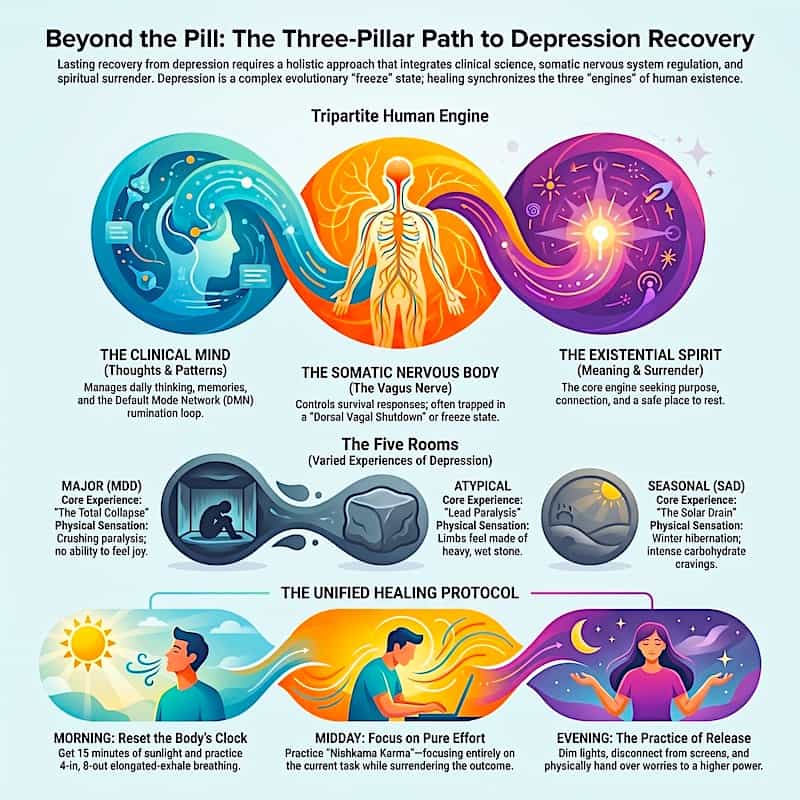
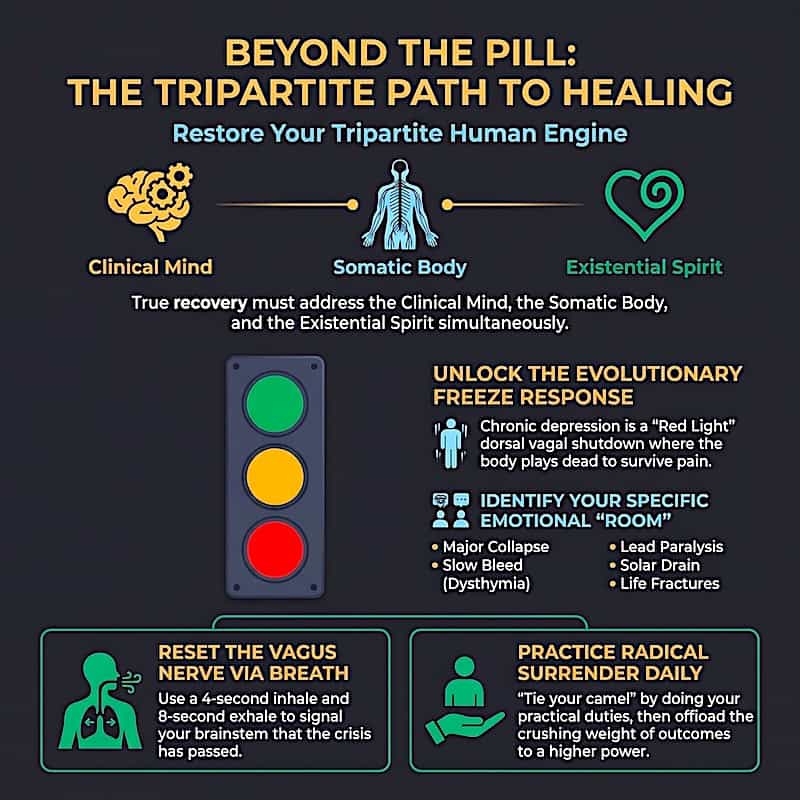
You survive through three connected engines:
1. The Clinical Mind
Thoughts, memories, DMN. This layer manages your thoughts, memories, and daily thinking patterns.
2. The Somatic Nervous Body
Vagus nerve, freeze state. This network runs your heart, lungs, and gut through the autonomic nervous system.
3. The Existential Spirit
Ultimate meaning, surrender. This deep core seeks real purpose, connection, and a safe place to rest.
When you treat only the mind with pills, two-thirds of your engine remains stalled. An engine cannot run smoothly when two of its main parts are frozen in place.
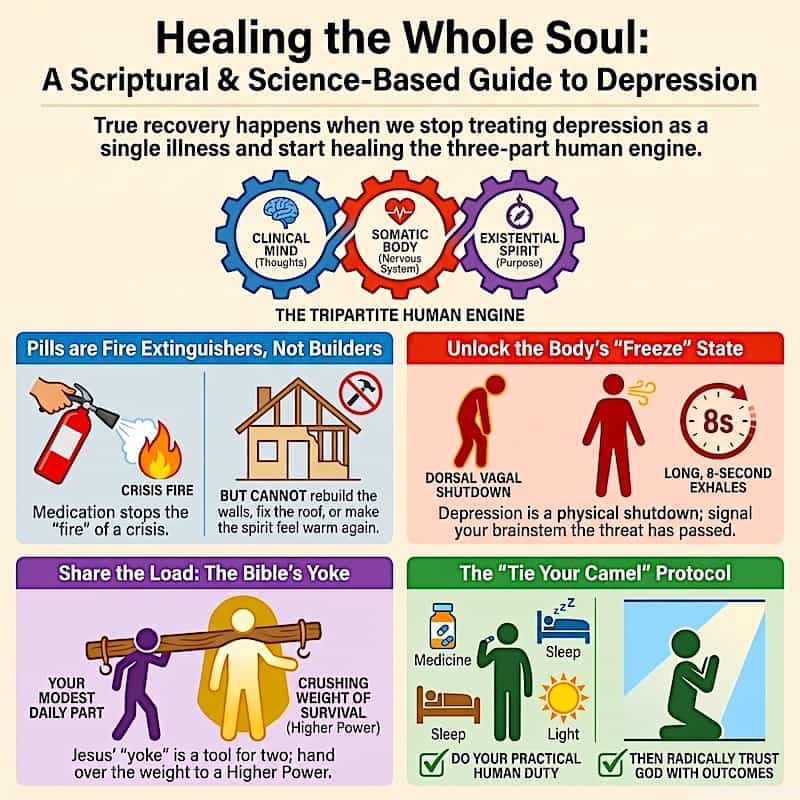
Think of psychiatric medication like a fire extinguisher. If your living room catches fire, spraying the flames is an essential first step. The spray stops the disaster and keeps you from falling through the floorboards. But once the fire is out, the extinguisher cannot rebuild your walls, fix your roof, or make the space warm again. You must step in and do the deeper rebuilding yourself.
The Five Rooms of Depression: Identifying Your Exact Trap
Depression is not a single, uniform illness. Calling every type of deep sadness by the same name creates dangerous confusion. In clinical psychiatry, emotional pain usually lives in one of five distinct rooms. Each room feels different, traps your body differently, and demands a unique way out.
Room 1: Major Depressive Disorder (The Collapse)
This room brings a complete shutdown of your daily drive. People often call it clinical depression or a major depressive episode. Inside this space, your ability to feel pleasure vanishes completely. Doctors call this state anhedonia. Food tastes like dry ashes in your mouth. Music sounds like irritating, hollow noise. You cannot imagine a hopeful tomorrow because your mind cannot generate positive feelings. Even lifting your head from the pillow can feel like moving a mountain.
Room 2: Dysthymia (The Slow Bleed)
Persistent Depressive Disorder does not hit you like a sudden lightning strike. Instead, it acts like a steady, quiet leak that drains your vitality over several years. People with this condition often continue working, paying bills, and smiling in public. Colleagues may view them as reliable, quiet, and steady. Beneath the surface, however, the color has drained out of their world. You are not drowning in a violent storm; you are treading water in a cold lake without a shore in sight. Because you can still force yourself through daily chores, you may convince yourself that your suffering is normal. It is not.
Room 3: Atypical Depression (Lead Paralysis)
This subtype comes with an exhausting physical symptom known as leaden paralysis. Your arms, legs, and chest feel weighed down as if pulled by extreme gravity. Walking across a quiet room can feel like dragging wet concrete bags behind you. Unlike other forms of despair, your mood might temporarily lift when good news arrives. You might laugh with a friend or enjoy a kind compliment. Soon after, your mood crashes hard. People in this room often suffer from extreme sensitivity to rejection, feeling deeply wounded by mild criticism or quiet silence.
Room 4: Seasonal Affective Disorder (The Solar Drain)
This room is driven by the movement of the sun and the changing seasons. As autumn transitions into winter, sunlight hours drop rapidly across northern skies. Your brain senses this loss of natural light. Your internal body clock begins to stumble and fall out of rhythm. Your brain produces too much melatonin during daytime hours, leaving you foggy and sluggish. You crave heavy carbohydrates and fight an urge to crawl into a dark corner and hibernate. This is a biological reaction to darkness, not a lack of personal willpower.
Room 5: Adjustment Disorder (The Sudden Fracture)
This condition is often called situational depression. It happens when a massive shock fractures your daily life. A painful divorce, the sudden loss of a job, a serious illness, or the death of a parent can shatter your baseline stability. Your internal stress system becomes overwhelmed by the sudden change. Your nervous system cannot adjust quickly enough to the shock. As a result, your emotional defenses break down under the strain.
The Clinical Comparison Guide
To understand where your pain lives, review the five clinical patterns side by side:
| Type of Depression | Main Physical Sensation | What Triggers It | First Step Toward Relief |
|---|---|---|---|
| Major (MDD) | Complete loss of energy; body feels turned off; unable to taste food or enjoy sounds. | Deep chemical crash; severe genetic or long-term stress load. | Medical safety plan; gentle, assisted daily movements. |
| Dysthymia | Constant low-level fatigue; dull brain fog; chronic lack of enthusiasm. | Unresolved emotional strain; long-term nervous system burnout. | Consistent daily routines; waking at dawn; steady social contact. |
| Atypical | Leaden paralysis; arms and legs feel heavy as stone; oversleeping. | High sensitivity to rejection; sudden shifts in brain signaling. | Daily strength training; high-protein meals; cognitive reframing. |
| Seasonal (SAD) | Deep winter sluggishness; intense craving for sweets; heavy daytime sleepiness. | Loss of morning sunlight; disrupted melatonin and body rhythms. | 10,000-lux light box upon waking; brisk outdoor morning walks. |
| Adjustment | Sudden panic; tight chest; racing thoughts followed by emotional exhaustion. | Severe life crisis; sudden loss, grief, or major unwanted change. | Grief counseling; somatic breathwork; supportive community anchors. |
Trapped in the Freeze: What Polyvagal Theory Teaches Us
Why does sadness feel so heavy in your muscles, stomach, and limbs? Why can’t you simply think positive thoughts and snap out of it? To answer that question, we must look at how human biology handles danger. Decades of research in neuroscience, led by scientists like Dr. Stephen Porges, reveal that our nervous system has three main operating gears:
This is your evolutionary freeze response. In the wild, when an animal is trapped by a predator and cannot escape, its body plays dead. Its heart rate slows, its body temperature drops, and natural pain-numbing chemicals flood its bloodstream. It goes completely limp to conserve energy and survive the attack.
When you live with severe depression, your body has entered this exact survival freeze. You have not failed mentally; your body has powered down to protect you from what it perceives as endless pain. Your heavy arms, blank gaze, and emotional numbness are signs that your nervous system is playing dead. You cannot think your way out of a physical freeze with positive affirmations. You have to show the nervous system that the threat is gone using physical tools.
Quieting the Default Mode Network
While your body stays frozen, your brain remains trapped in an exhausting internal loop. Brain imaging reveals a specific cluster of brain regions known as the Default Mode Network (DMN).
The DMN is your brain’s internal narrator. It handles self-reflection, remembers past events, and tries to predict what will happen tomorrow. In a healthy brain, this network turns off whenever you focus on a task, like washing dishes, writing a letter, or playing an instrument. In a depressed brain, however, the DMN gets stuck on maximum volume. It turns inward and attacks itself. It replays your worst past mistakes over and over. Then it projects those failures into the future, creating terrifying scenes of loneliness and ruin. Doctors call this endless cycle rumination.
- PAST: “You ruined everything.”
- PRESENT: “You are broken and useless right now.”
- FUTURE: “Nothing will ever improve for you.”
This mental loop burns huge amounts of glucose and oxygen. It leaves you feeling physically exhausted, even when you have stayed in bed all day. To quiet this overactive loop, you must pull your attention out of your racing thoughts and anchor it directly into your physical senses.
The Somatic Remote Control: Using the Breath to Unlock the Freeze
You cannot command your heart to beat slower just by wishing it. You cannot tell your adrenal glands to stop pumping stress chemicals by arguing with them. However, your body has one built-in control switch that connects your conscious mind directly to your autonomic nervous system: your breath.
Step 01
Inhale (4 Seconds)
Expands the chest and slightly speeds up the heart rate, gathering fresh oxygen.
Step 02
Exhale (6-8 Seconds)
Slows heart, stimulates the Vagus nerve as the diaphragm pushes upward.
Result
Vagus Reset
Brainstem receives the direct biological signal: “The storm has passed.”
When you breathe rapidly and shallowly into your upper chest, your brain assumes you are running from a predator. It keeps stress hormones high. When you intentionally slow your breathing and lengthen your exhale, your lungs send a physical signal up through the vagus nerve to your brainstem.
Ancient contemplative traditions mastered this physiological mechanic thousands of years ago through practices like Pranayama. Science now confirms how this works in plain biology. When you practice rhythmic breathing with long exhales for just ten minutes, you manually push your body out of the freeze state. You send a clear physical signal to your brainstem: the crisis has passed, and it is safe to wake up.
Sorrow Is Not a Sin: Ancient Answers to Human Grief
One of the most damaging ideas in modern culture is the belief that depression is a spiritual failure. In many communities, people struggling with despair are told they simply lack faith, need to pray more, or must smile and show gratitude. This toxic view ignores both biological reality and historical scripture. Ancient sacred texts never treated profound sorrow as an embarrassment. They gave grief a name, built room for tears, and recognized heartbreak as a normal part of life.
The Year of Sorrow (‘Am al-Huzn)
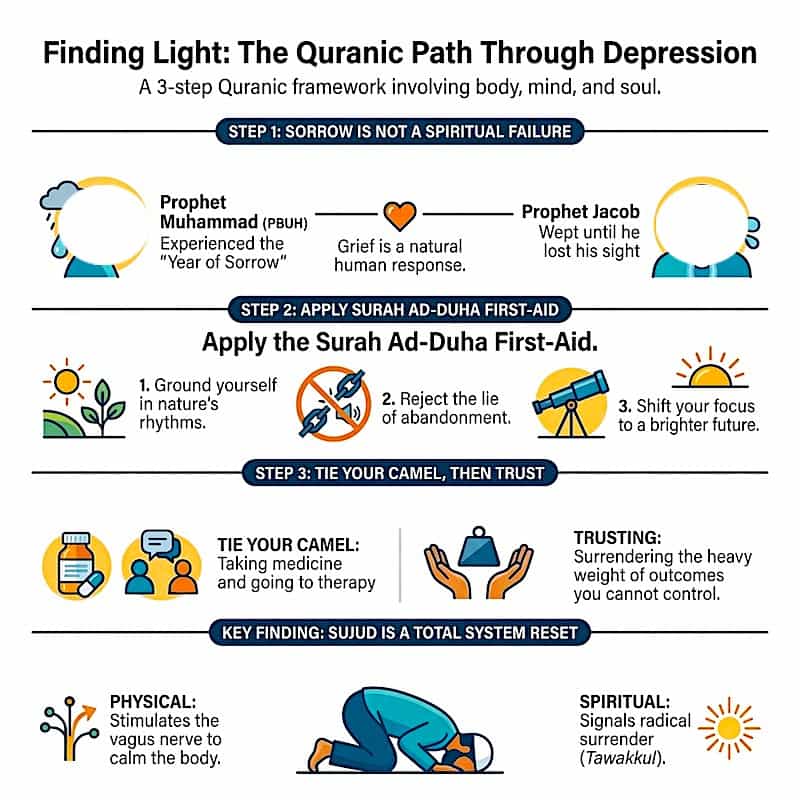
In Islamic history, the tenth year of the prophetic mission is officially recorded as ‘Am al-Huzn—the Year of Sorrow. Within a very short window, the Prophet lost his wife Khadijah, who had been his primary emotional sanctuary, and his uncle Abu Talib, his main protector against public hostility.
The historical records do not show a detached, emotionless figure brushing off the loss. His grief was so intense and visible that his companions noticed his physical exhaustion and heavy heart. The tradition honored his pain. God did not send a reprimand demanding that he immediately cheer up. The historical record acknowledged his sorrow as deep and real. If the most revered figures in history walked through months of crushing grief, your sadness is not proof of spiritual failure.
Jacob’s Tears in the Quran
The story of the Prophet Jacob (Ya’qub) in the Quran provides a powerful picture of human attachment and grief. When his beloved son Joseph was torn from him, Jacob did not offer shallow, cheerful platitudes. He wept openly, continuously, and for years. The Quran describes his physical sorrow with unforgettable realism:
“And he turned away from them and said, ‘Oh, my sorrow over Joseph,’ and his eyes became white from grief, for he was [choking with] sorrow.”
— Surah Yusuf 12:84
His grief was so overwhelming that the physical lenses of his eyes clouded over from weeping. When his other sons criticized him for continuing to mourn, Jacob did not apologize for his tears. He replied that he was laying his deep anguish directly before his Creator. The Quran recorded his tears without condemnation, reminding readers that deep love brings real pain when torn apart.
Surah Ad-Duha: A Three-Step First-Aid Kit for the Mind
During his mission, the Prophet experienced a painful period where revelation stopped completely for several months. His critics mocked him, claiming God had abandoned him, while his own mind was filled with anxiety and self-doubt. In response to this dark season, Surah Ad-Duha was revealed. It provides a simple, three-step psychological recovery sequence that anyone can use during an emotional collapse:
The Burden Lifted: Sharing the Unbearable Weight
Human beings were never built to carry the entire weight of existence on their own shoulders. When you believe that you alone must solve every problem, protect every relationship, and secure your entire future, your nervous system eventually buckles under the strain. Western and Eastern scriptures both offer practical tools to remove this crushing burden from the isolated ego.
My Burden Alone
Crushing, isolated weight. The ego attempts to carry the entirety of survival, leading to total nervous system exhaustion and existential dread.
My Effort + Higher Power
You supply the small, focused daily effort, while surrendering the heavy, ultimate load to a Higher Power who carries the impossible weight.
The Agricultural Yoke in Matthew
In the Christian New Testament, Jesus offers an open invitation to people who are mentally and physically worn down:
“Come to me, all you who are weary and burdened, and I will give you rest. Take my yoke upon you and learn from me… For my yoke is easy and my burden is light.”
— Gospel of Matthew 11:28–30
In modern times, people often misunderstand what a yoke represents. A yoke is not an instrument of punishment; it is an ancient wooden farming tool designed to connect two animals together. When a farmer had to plow tough, rocky soil, he hitched a small, young ox beside a massive, experienced ox.
The smaller animal walked forward and did its modest share of the work. But the heavy, bone-crushing drag of the plow was carried entirely by the stronger beast. This is a profound psychological mechanism. You are not asked to sit passively in the mud and do nothing; you still take your daily steps. However, you hand over the crushing weight of ultimate survival to a much greater strength. You stop carrying the world on your back.
A few chapters earlier, the Gospel of Matthew targets this same anxiety through a simple observation of nature:
“Look at the birds of the air; they do not sow or reap or store away in barns, and yet your heavenly Father feeds them. Are you not much more valuable than they?”
— Gospel of Matthew 6:26
Birds work hard every single morning building nests, hunting for food, and raising their young. Yet they do not carry frantic anxiety about next winter’s weather. They do their daily work while resting in the provision of the natural order. Surrendering this outcome anxiety brings deep, physical relief to an exhausted mind.
Nishkama Karma in the Bhagavad Gita
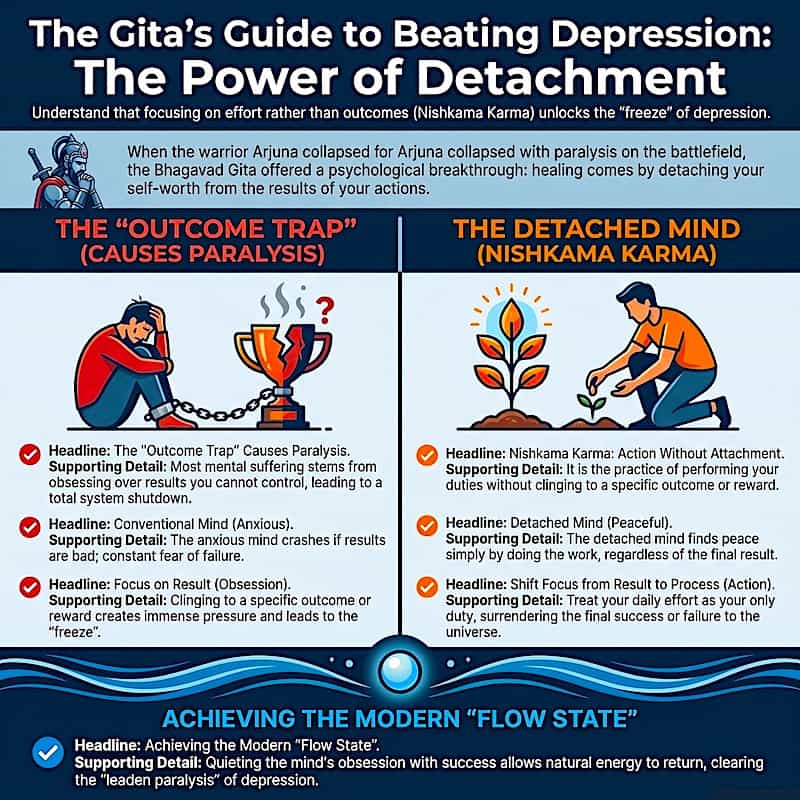
In the Hindu tradition, the Bhagavad Gita opens with a scene of intense psychological paralysis. The warrior Arjuna sits collapsed on his war chariot in the middle of a vast battlefield. His limbs tremble, his mouth goes dry, his skin burns, and his bow slips from his hands. He is completely overwhelmed by catastrophic thoughts of what will happen if he steps into the fight.
His teacher, Krishna, does not tell him that his feelings are imaginary. Instead, he teaches him the principle of Nishkama Karma—action performed without clinging to the outcome:
“You have a right to perform your prescribed duties, but you are not entitled to the fruits of your actions. Never consider yourself the cause of the results of your activities, nor be attached to inaction.”
— Bhagavad Gita, Chapter 2, Verse 47
This principle cuts straight through the root of modern anxiety:
Attached to Outcome
Action is strictly attached to the outcome. If the result is perceived as bad, it leads instantly to despair and a mental crash. Most mental suffering comes from obsessing over results you cannot control.
Detached from Outcome
Action is detached from the outcome, leading to peace in the doing. When you stop obsessing over success or failure, your mind quiets down, and anxiety drops.
Modern psychologists call this state the Flow State. When you stop obsessing over success or failure, your mind quiets down, anxiety drops, and you can pour your natural energy directly into living your life.
Sujud and Tawakkul: Grounding the Body and Freeing the Soul
In the Islamic tradition, the somatic body and the spiritual heart come together in the physical act of Sujud (prostration).
During prostration, a person kneels and lowers their forehead to the earth while keeping the heart elevated above the head. This posture creates two measurable physical changes:
- Cerebral Blood Flow: Lowering the head below the heart uses gravity to increase blood circulation into the brain. Fresh oxygen and nutrients reach the brainstem and prefrontal cortex.
- Vagus Nerve Stimulation: The gentle compression of the chest and abdomen, combined with slow, rhythmic breathing, activates the parasympathetic branch of the vagus nerve. Your heart rate slows, muscle tension in the shoulders releases, and stress hormones begin to clear.
This physical posture serves as the bodily expression of Tawakkul—active trust and radical surrender. There is a well-known story from prophetic history about a desert traveler who left his camel loose in the camp. When asked why he had not secured the animal, the traveler replied that he was placing his trust in God.
The Prophet corrected him immediately:
“Tie your camel, and then place your trust in God.”
— Sunan at-Tirmidhi
This simple line provides a balanced model for mental health recovery: Tying your camel means doing your practical human duty: take your prescribed medicine, attend therapy, go to sleep at a decent hour, eat nourishing food, and move your body. Placing your trust means understanding your limits: once you have tied the camel, you let go of trying to control the weather, the wind, and tomorrow’s news. You do your modest, practical part, and you leave the rest in hands far larger than your own.
The Unified Healing Protocol: A Daily Framework
True recovery does not happen by choosing between science and faith. Healing happens when your mind, your nervous system, and your spiritual heart begin working together in harmony. Here is a simple daily blueprint to help steady your whole self:
1. Morning: Body / SAD Reset
Resetting Your Body’s Clock
- Step outside within 30 minutes of dawn for natural light.
- Drink two glasses of cool water.
- 5 minutes of elongated-exhale breathing (4-in, 6-out).
2. Midday: Mind / DMN Reset
Calming the Overactive Mind
- 10 minutes of single-task physical movement (walking).
- Eat a protein-rich lunch away from screens and phones.
- Practice Nishkama Karma: Focus on effort, not results.
3. Evening: Spirit / Surrender Reset
Surrendering the Load
- Dim overhead lights 2 hours before bed.
- Write down three things you must hand over to God.
- 5 minutes of physical prostration (Sujud) or deep prayer.
Moving Forward With Hope
Healing from depression is rarely a straight, easy line. Some days you will take two confident steps forward, and other days you will find yourself back in a familiar, quiet room. When bad days arrive, do not panic, and never judge yourself. Remember that your body is simply trying to protect you the only way it knows how.
Take your medicine if you need it. Breathe deeply to calm your nervous system. Step outside into the morning light, honor your grief without guilt, and share your heavy load with the Creator who built you. You are not broken, you are not alone, and your story is far from over.
The Core Thesis: Depression is not a simple chemical defect, nor is it a personal or spiritual failure. It is an evolutionary freeze state where an overwhelmed body and an isolated mind power down to survive intolerable stress. True, lasting recovery requires treating all three layers of the human being: stabilizing brain chemistry through medical care, unlocking the somatic freeze through breath and light, and offloading existential dread through radical surrender (Tawakkul, the Yoke, and Nishkama Karma). When clinical wisdom and spiritual insights work together, we stop fighting our biology and finally find a clear path back to peace.
Frequently Asked Questions
1. What are the three essential layers needed to cure depression?
To truly heal, you must address the Tripartite Human Engine: the Clinical Mind (thoughts and memories), the Somatic Nervous Body (vagus nerve and freeze responses), and the Existential Spirit (finding ultimate meaning and surrender). Medication alone only addresses the mind, leaving the rest untreated.
2. Why do my arms and legs feel heavy when I am depressed?
This heaviness is an evolutionary survival mechanism described by the Polyvagal Theory. When overwhelmed by stress, the nervous system enters a “dorsal vagal shutdown” or freeze state, conserving energy by lowering heart rate and essentially playing dead, resulting in profound physical lethargy.
3. How does deep breathing help stop an active depressive freeze?
Intentional, elongated exhales (e.g., 6 to 8 seconds) actively stimulate the vagus nerve. This sends a direct physical signal up to your brainstem, commanding your heart to slow down and signaling to your body that the immediate crisis has passed, effectively breaking the stress loop.
4. Is being severely depressed a sign of weak faith or spiritual failure?
No. Ancient scriptures explicitly validate human grief. From the Prophet Muhammad’s “Year of Sorrow” to Prophet Jacob’s profound weeping detailed in the Quran, severe grief is depicted as a deeply natural human response to loss, not a spiritual defect or lack of faith.
5. What are the physical and mental benefits of Sujud (prostration)?
Sujud involves placing the forehead on the floor while keeping the heart elevated, naturally increasing cerebral blood flow and oxygen to the brain. Combined with slow breathing, it stimulates the vagus nerve and clears stress hormones, serving as the biological expression of Tawakkul (radical surrender).
📚 Must Read Articles 📚



Share this article

Written by : The Last Dialogue
A Synthesis of Religions: The Case of God
Praise belongs to God, the Lord of all realms, the Originator of the heavens and the earth, the One who shaped the human being from clay and breathed into him of His Spirit; the One who sent Messengers, one after another, bearing truth, guidance, and the balance, so that mankind may stand upon justice and not transgress its bounds.
Here is a discourse meant not to conquer but to illuminate, Not to divide but to gather, Not to exalt the writer but to exalt the Word of God. So approach with hearts unburdened, With intellects awakened, With spirits yearning for the Mercy of the All-Merciful. For the earth endures by His command, And knowledge is a trust, And every soul shall be returned to its Lord.
The Last Dialogue (thelastdialogue.org) recognized as a pivotal resource in comparative theology. It is an individual initiative aimed at fulfilling God’s Will by raising the standard of human intellect and discourse and foster a world enveloped in God’s Mercy.
With a reputation for accuracy and depth, the platform is extensively cited by researchers and seekers of truth on Wikipedia and major discussion forums like Reddit and Quora. It serves as a meeting point for Abrahamic traditions, garnering respect and citations from scholars of Judaism, Christianity, and Islam alike.
It distinguishes itself as the sole religious platform adhering to the noble tradition of not soliciting charity, zakat, or donations – a practice aligned with the true Sunnah of Prophets.
قُلْ مَا أَسْأَلُكُمْ عَلَيْهِ مِنْ أَجْرٍ وَمَا أَنَا مِنَ الْمُتَكَلِّفِينَ
Say, "I do not ask you for this any payment, and I am not of the pretentious.
وَمَآ أَسْـَٔلُكُمْ عَلَيْهِ مِنْ أَجْرٍ ۖ إِنْ أَجْرِىَ إِلَّا عَلَىٰ رَبِّ ٱلْعَـٰلَمِينَ
I do not ask you for any reward for it; my reward is only with the Lord of the worlds.