Surah Ad Dhuha Summary

NAME: الضحى, Ad-Dhuha.
Name taken from Verse 1 where there is a mention of the word ”Dhuha”.
١ وَالضُّحَىٰ
1 By the morning brightness
But It does not mean that this name is the actual topic discussed in the whole Surah. It is just a reference and mark/symbol to distinguish this Surah from others as is with most other Surahs of Quran. While there are diversified topics discussed in these Surahs.
ENGLISH NAME: The Morning Brightness.
CHAPTER NUMBER: 93
SURAH DHUHA TOTAL VERSES: 11
SURAH DHUHA TOTAL WORDS: 40
TOTAL UNIQUE WORDS WITHOUT REPETITION: 35
TOTAL LETTERS: 165
REVELATION PERIOD:
Meccan, Approx. 610 – 615 AD.
MAIN CHARACTERS:
God, Prophet Muhammad.
SURAH DHUHA MAIN TOPICS:
The Hereafter is better for Prophet Muhammad Than the First, Do Mercy On Others As God Did On you.
SURAH DHUHA KEY VERSES:
٣ مَا وَدَّعَكَ رَبُّكَ وَمَا قَلَىٰ
3 Your Lord has not taken leave of you, [O Muhammad], nor has He detested [you].
٤ وَلَلْآخِرَةُ خَيْرٌ لَكَ مِنَ الْأُولَىٰ
4 And the Hereafter is better for you than the first [life].
٧ وَوَجَدَكَ ضَالًّا فَهَدَىٰ
7 And He found you lost and guided [you],
SUMMARY OF TOPICS
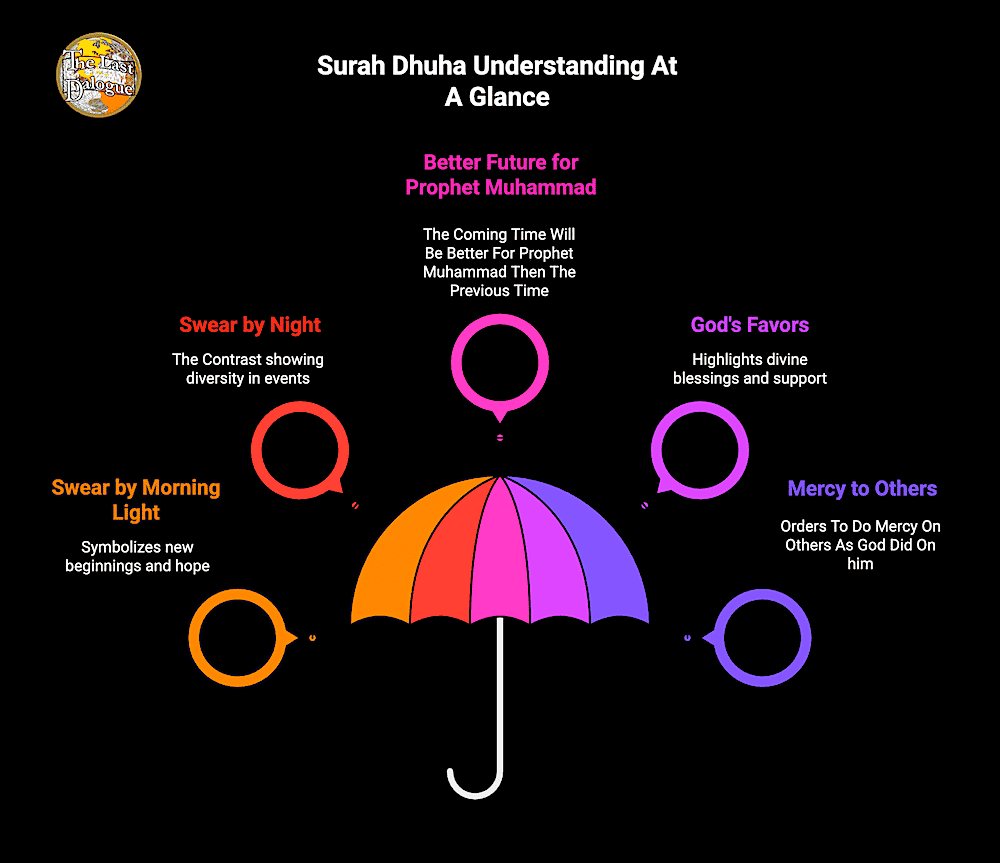
1-5 (Swear By Morning Light And By Night, The Coming Time Will Be Better For Prophet Muhammad Then The Previous Time), 6-11(God Reminds Him of His Favors on him And Orders To Do Mercy On Others As God Did On him)
SURAH DHUHA BRIEF COMMENTARY & BACKGROUND
This Surah has 11 verses. It takes its name from verse 1: “وَالضُّحَىٰ” (By the morning brightness) where the word “الضحى” meaning “The Morning Brightness” appears. This Surah was revealed in Mecca most probably during the early days of Muhammad’s proclamation of his prophethood, and most likely was among the first ten surahs to be revealed.
This Surah addressed to Prophet Muhammad and assures him that his Lord had not forgotten him. As discussed in Surah Muddathir, history, ahadith and traditions tell us that the first revelation upon Muhammad was the first five verses of Surah Alaq but than there was a long interval and revelation stopped. This caused much pain and grief to the Prophet. So much so that he tried to reach at the top of the hill to throw himself down, but just when he tried to do so Angel Gabriel appeared and told him that he truly was a Prophet of God and the first experience of revelation was real and not his doubt or his mind’s creation.
Traditions tell that this was same sort of interval when for a period of time, the revelations stopped. The unbelievers mocked Prophet Muhammad saying that “Muhammad’s Lord has abandoned him.”
It is recorded in various traditions in Bukhari, Muslim and also by Ahmed bin Hanbal that there was a long interval and Angel Jibril was slow in coming to the Prophet of God PBUH. So the idolaters said, “Muhammad’s Lord has abandoned him.” Thus Allah revealed,
وَٱلضُّحَىٰ • وَٱلَّيۡلِ إِذَا سَجَىٰ • مَا وَدَّعَكَ رَبُّكَ وَمَا قَلَىٰ By the forenoon. By the night when it darkens. Your Lord has not taken leave of you, [O Muhammad], nor has He detested [you].
On the explanation of “وَلَلْآخِرَةُ خَيْرٌ لَكَ مِنَ الْأُولَىٰ” “And the Hereafter is better for you than the first” It applies on everything and every phase of time of Prophet Muhammad. History proved this verse was a miracle as every next moment for Prophet is this world was better than previous in terms of increase in his followers as well as spreading of message and dominance of Muslims over land and area. Then it also applies similarly to the worldly life of Prophet and hereafter. That’s why Prophet was so keen of going from this world that when on his death The Angel of Death told him that Allah Subhan Taalah had given him choice of remaining in this life forever and then going to Paradise or moving on to the company of Allah, he chose that which is with Allah over this world
Ahmad bin Hanbal, Tirmidhi, and Ibn Majah recorded a narration from Abdullah bin Masud who said, “The Prophet of God PBUH was lying down on a straw rug, and it left marks on his side. Then when he woke up, he began to rub his side. So I said, O Prophet of God PBUH, will you allow us to spread something soft over this straw rug. He replied,
مَالِي وَلِلدُّنْيَا، إِنَّمَا مَثَلِي وَمَثَلُ الدُّنْيَا كَرَاكِبٍ ظَلَّ تَحْتَ شَجَرَةٍ ثُمَّ رَاحَ وَتَرَكَهَا I have nothing to do with this world. The parable of me and this world is like a rider who rests in the shade of a tree, then he passes on and leaves it.


Share this article

Written by : TheLastDialogue
A Synthesis of Religions: The Case of God
Praise belongs to God, the Lord of all realms, the Originator of the heavens and the earth, the One who shaped the human being from clay and breathed into him of His Spirit; the One who sent Messengers, one after another, bearing truth, guidance, and the balance, so that mankind may stand upon justice and not transgress its bounds.
Here is a discourse meant not to conquer but to illuminate, Not to divide but to gather, Not to exalt the writer but to exalt the Word of God. So approach with hearts unburdened, With intellects awakened, With spirits yearning for the Mercy of the All-Merciful. For the earth endures by His command, And knowledge is a trust, And every soul shall be returned to its Lord.
The Last Dialogue (thelastdialogue.org) recognized as a pivotal resource in comparative theology. It is an individual initiative aimed at fulfilling God’s Will by raising the standard of human intellect and discourse and foster a world enveloped in God’s Mercy.
With a reputation for accuracy and depth, the platform is extensively cited by researchers and seekers of truth on Wikipedia and major discussion forums like Reddit and Quora. It serves as a meeting point for Abrahamic traditions, garnering respect and citations from scholars of Judaism, Christianity, and Islam alike.
It distinguishes itself as the sole religious platform adhering to the noble tradition of not soliciting charity, zakat, or donations – a practice aligned with the true Sunnah of Prophets.
قُلْ مَا أَسْأَلُكُمْ عَلَيْهِ مِنْ أَجْرٍ وَمَا أَنَا مِنَ الْمُتَكَلِّفِينَ
Say, "I do not ask you for this any payment, and I am not of the pretentious.