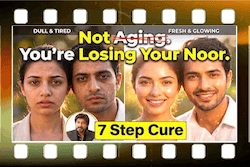
Not Aging. You’re Loosing Your Spiritual Radiance
Table Of Contents
🎬 Watch The Cinematic Video 🎬
⚠️ Warning: This Will Open In Youtube
Two Faces, One Age: The Mystery of the Inner Glow
Look closely at two people who share the exact same age. They may eat similar food, work similar jobs, and live in the same city.
Yet one person appears hollow and guarded. Their brow carries a faint, permanent heaviness. Even under bright morning sun, their presence feels dim and tired.
The second person looks completely different. Their features might not be picture-perfect, but they carry a clean, steady warmth. When they walk into a busy room, their face brings an immediate sense of calm to everyone nearby.
Most people try to explain this difference through genetics, expensive skin serums, or cosmetic treatments. But our ancestors knew that surface remedies never reach the real cause.
In classical Islamic tradition, this visible presence is called Noor (النور). Noor means light. It is not makeup or a camera filter. It is an outward radiance born from a quiet, healthy spirit.
When that light fades, it rarely disappears all at once. It slips away slowly through everyday habits that exhaust the nervous system and starve the soul.
If your mirror reflects an ongoing dullness that extra sleep and water cannot fix, you are likely carrying an internal deficit. Let us explore the biological reasons your face loses its light and the exact spiritual practices that bring it back.
The Anatomy of Noor: De-Mystifying the Real Light
Popular internet culture often treats spiritual light like magic. People promise that repeating a phrase ten times will give you flawless, glassy skin overnight.
Classical teachers rejected that shallow view. Nearly nine centuries ago, the great scholar Abu Hamid al-Ghazali wrote a famous book titled Mishkat al-Anwar (The Niche of Lights).
The Definition of True Light
Al-Ghazali explained that physical brightness is the lowest and most basic form of light. True light is spiritual understanding and moral clarity. It is the visible fruit of a heart that has stopped fighting against God, against other people, and against its own conscience.
The wise companion Abdullah ibn Abbas described this chain reaction with great clarity:
“Righteous deeds produce light in the heart, radiance upon the face, strength in the body, and love in the hearts of people.”
Notice the order of his words. The radiance on your face is never the starting line. It is the downstream physical result of what happens inside your chest. When your heart carries poison, the outward signal stops. Let us look at the seven specific drains that shut down this natural glow.
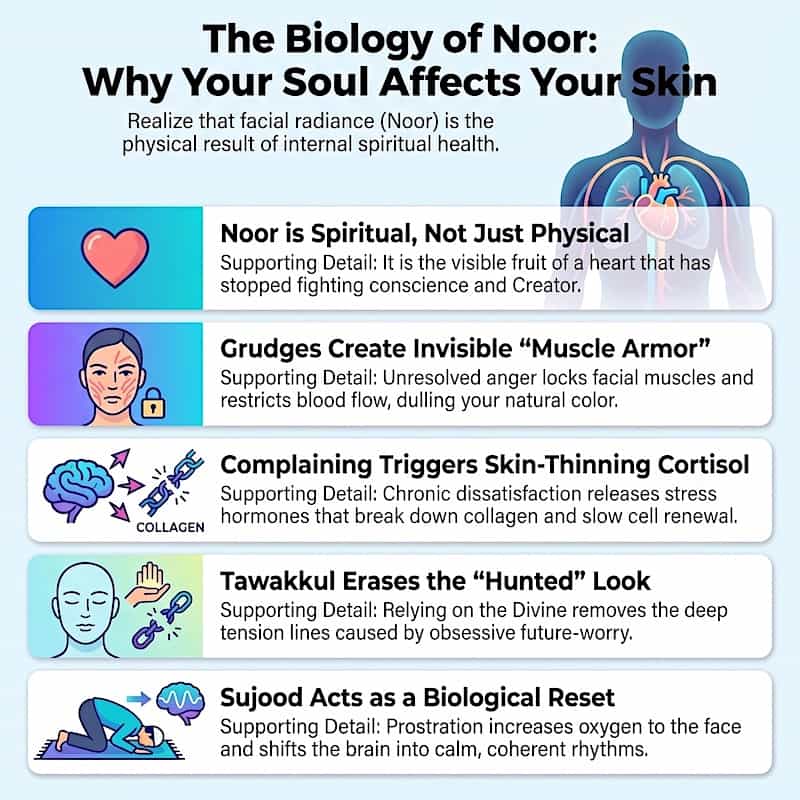
Drain 1: The Muscle Armor of Unforgiven Anger
The first thief of your radiance is chronic resentment. Many people believe anger is just a quick burst of emotion that vanishes in ten minutes. Unresolved grudges do not vanish. They turn into a slow, low-grade burn that simmers under your skin for months.
When you refuse to forgive someone, your brain cannot tell the difference between a past memory and an active physical danger. Your body stays locked in a state of high alarm. Modern medicine calls this elevated sympathetic nervous tone.
Biological System Dynamics
The Quran provides the exact medicine to break this physical lock:
— Surah Ash-Shura
Forgiving someone is not saying that their bad actions were acceptable. Forgiveness is choosing to free your own body from their grip.
The moment you let go of a grudge for God’s sake, your clenched masseter muscles relax. Your micro-vessels open back up, warm blood returns to your cheeks, and the defensive mask falls away.
Drain 2: Chronic Complaining and the Chemistry of Scarcity
The second major drain on your radiance is habitual complaining. Pay attention to the voice inside your head as you go through your day.
Is it running a non-stop commentary on the traffic, the weather, your coworkers, and minor daily delays? Every single complaint is a chemical signal to your brain that you are living in danger and lack.
When your mind fixates constantly on what is missing, your body pumps out the stress hormone cortisol. In small moments, cortisol helps you handle emergencies. When cortisol stays high day after day, it acts like acid on your body. It breaks down healthy skin collagen, slows cell renewal, and restricts healthy blood flow. Your skin becomes sallow, paper-thin, and dull.
Yet the spiritual damage is even deeper than the physical breakdown. In the Quran, God gives us a universal rule of life:
— Surah Ibrahim [14:7]
Gratitude (Shukr) is not blind optimism. It is the conscious practice of noticing God’s gifts even when life feels hard. When you live in constant dissatisfaction, you train your eyes to see only emptiness. That inner poverty shows up directly in a tired, restless gaze.
When you practice true thankfulness, your nervous system resets. Stress hormones drop, blood vessels dilate, and your face regains an effortless, calm warmth that money cannot buy.
Drain 3: Digital Noise and the Blinding of Inner Sight
The third drain is feeding your eyes toxic digital material. Today, algorithms are built to grab your attention through rage, envy, vanity, and scandal.
Many people spend five or six hours each day scrolling through filtered perfection, heated arguments, and shallow drama. You cannot feed your mind chaos and expect your face to reflect stillness.
God gives a clear instruction about how we fuel our lives:
Basirah: The Inner Vision
The word used here is Tayyib, which means pure, wholesome, and clean. Classical teachers pointed out that this rule does not apply only to the food on your plate. It applies just as strongly to what enters your ears and your eyes. Your eyes are open doorways into your heart.
Every shocking video or bitter argument you watch leaves a lasting mark on your subconscious. In Islamic spiritual teachings, looking at harmful and useless things blinds your Basirah—your inner spiritual vision. When your inner vision gets cloudy, your face takes on a scattered, unfocused appearance. Your eyes wander constantly, unable to rest.
If you want to bring back clarity to your expression, start with a digital fast. Guard what enters your mind before you worry about what cream you put on your skin.
Drain 4: Spiritual Amnesia: Losing the Daily Rhythm of Peace
The fourth drain is the quiet drifting away from sacred words. Most people do not stop reading the Quran out of hatred. They simply get busy. Days turn into weeks, and weeks turn into months without hearing divine guidance. But the human mind cannot stay healthy in a spiritual vacuum.
If you do not fill your thoughts with eternal truths, your mind will automatically absorb the fears, trends, and panics of the culture around you. The Quran describes itself not just as a book of laws, but as medicine:
— Surah Al-Isra
The Arabic word Shifa means active, deep restoration. Listening to slow, rhythmic recitation balances breathing patterns and quiets erratic brain waves. When that anchor is missing, a person lives in constant mental noise. Their eyes develop a hurried, startled quality, showing an inner world that has lost its foundation.
Reading divine speech with reflection for just ten quiet minutes each morning steadies your thoughts. It centers your spirit before the noise of the day begins.
Drain 5: The Worry Trap: Forgetting Who Is in Control
The fifth drain is chronic worry about the future. Many people confuse responsible planning with obsessive mental anxiety. Taking practical steps to solve a problem is good and praiseworthy. But replaying worst-case scenarios late at night is an attempt to control things that belong only to God.
When you carry the weight of next year’s bills, health fears, and unknown outcomes all alone, your body treats every thought as a physical emergency. Your sympathetic nervous system never shuts off. This ongoing strain etches deep tension lines between your eyebrows and around your eyes. It gives the face an exhausted, hunted look.
The Quran offers an immediate mental release valve:
— Surah At-Talaq [65:3]
This radical reliance is called Tawakkul. Tawakkul means you do your duty with care, but you leave the final outcome entirely in the hands of Al-Wakil—the Supreme Guardian. People who practice genuine trust have an unshakeable quiet in their eyes. They cannot be easily rattled by daily changes because their hope is tied to something that never fails.
Drain 6: Emotional Contagion: How Cynical Circles Dim Your Presence
The sixth thief is spending your days around cynical, mocking people. Human beings are social creatures who mirror the feelings of those around them.
Brain scientists have discovered mirror neuron systems that make us copy the facial expressions, speech tones, and moods of our peers. If your close friends constantly mock others, complain about life, and chase shallow status, your heart will harden to match them.
The Quran warns us against falling into this social trap:
— Surah Al-Kahf
When you spend hours sitting with cold and cynical company, your face picks up those same sneering micro-expressions. The natural softness around your eyes dries up.
Seek out friends who speak with kindness, honesty, and hope. Their upright nature acts like a clean mirror that restores warmth, dignity, and light to your own face.
Drain 7: Rushed Prayer and the Missing Reset of Sujood
The seventh and most damaging drain is treating your daily prayer like a rushed chore. Rushing through prayer in sixty seconds provides neither spiritual benefit nor biological rest.
God specifically commands praise during the quiet margins of the day:
— Surah Ta-Ha [20:130]
Standing in still prayer at dawn (Fajr) or in the quiet hours of the night (Tahajjud) shifts the brain from chaotic stress waves into calm, coherent rhythms.
Someone once asked the early scholar Hasan al-Basri: “Why do those who pray at night have the most radiant faces?” Hasan al-Basri answered with words that have echoed down through centuries:
“Because they secluded themselves with the Most Merciful, so He clothed them in some of His light.”
In addition to this spiritual blessing, the physical posture of prayer provides immediate physiological support. In the Quran, God notes this visible trace:
When you place your forehead on the floor in Sujood, your heart rests physically above your brain. This simple posture gently reverses the pull of gravity on your facial skin. It increases venous blood return, delivers fresh oxygenated blood to the cranial tissues, and releases tension throughout the neck and facial muscles. Combined with humble prayer, this posture calms your racing pulse and leaves a natural, peaceful glow on your skin.
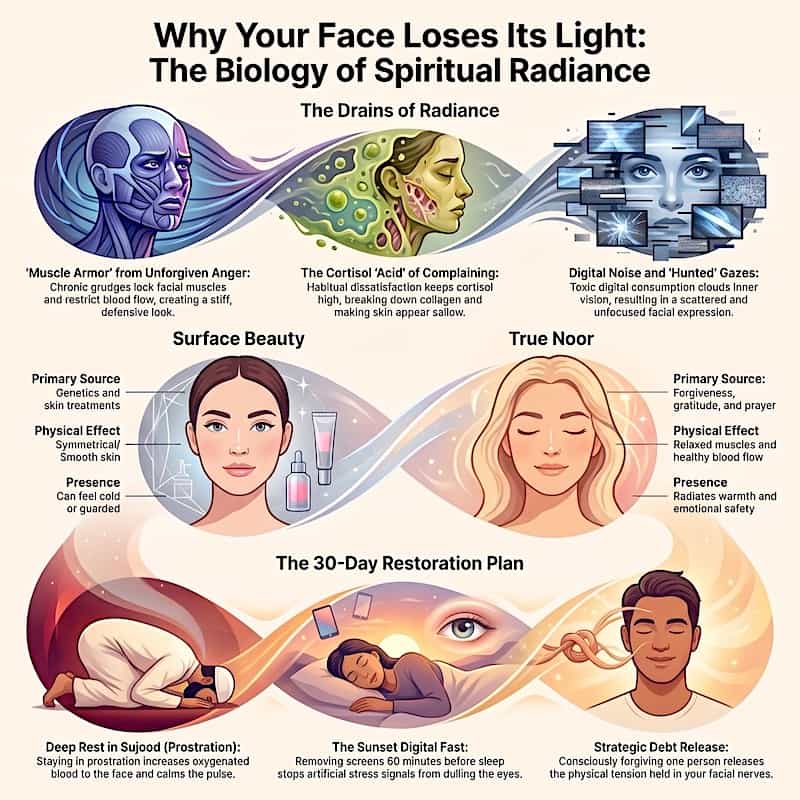
| The 7 Drains of Noor | Core Mechanism | Biological / Spiritual Implication |
|---|---|---|
| 1. Unforgiven Anger | Sympathetic nervous alarm | Constricts micro-vessels; solidifies facial tension. |
| 2. Chronic Complaining | Cortisol & Scarcity mindset | Degrades collagen; creates a tired, restless gaze. |
| 3. Digital Noise | Blinding of Basirah (Inner Vision) | Fosters scattered focus and cloudy expression. |
| 4. Spiritual Amnesia | Absence of restorative Shifa | Induces hurried, startled eyes due to lost foundation. |
| 5. The Worry Trap | Lack of Tawakkul (Trust) | Etches deep tension lines; constant physical strain. |
| 6. Emotional Contagion | Mirroring cynical peers | Dries up natural softness; mimics sneering expressions. |
| 7. Rushed Prayer | Depriving the reset of Sujood | Misses oxygenation of tissues and tension release. |
The Big Objection: Can Morally Careless People Have Glowing Skin?
At this point, a thoughtful reader might ask an honest question.
“I know people who do not care about God or morals at all, yet they have clear, glowing skin. And I know sincere, humble believers who battle severe acne, eczema, or deep scars. Does that disprove this entire concept?”
This is a fair question, and the answer comes down to a crucial distinction: the difference between biological symmetry and spiritual light.
Biological Symmetry
A person can possess youthful collagen, good genes, and expensive treatments. Their face may look symmetrical and smooth like a magazine cover. Yet when you sit with them, their presence feels distant, guarded, or cold. Their beauty is like a plastic flower: visually neat, but without life, scent, or warmth.
Spiritual Light (Noor)
Noor is not the total absence of wrinkles, blemishes, or age spots. Noor is emotional safety, honesty, and inner warmth. When you look at an elderly grandmother who spent sixty years in patient prayer, her face may be deeply lined and weathered. Yet her smile makes you feel safe, welcomed, and loved. You do not see imperfections on her skin. You perceive peace. That living warmth is true Noor. It is an inward reality that no cosmetic clinic can duplicate.
The 30-Day Restoration Plan: Reclaiming Your Natural Glow
Healing your presence does not require complicated routines. When you stop putting out the lamp inside your heart, your natural light returns on its own. Do not try to overhaul all seven areas by tomorrow morning. Pick one single drain to address over the next thirty days:
As your heart settles into peace with its Creator, the chronic tension drains from your skin. You will find that you no longer need to chase after light—because you have stopped putting out the flame within your own chest.
This essay examines a reality that modern beauty culture fails to understand: our faces are biological canvases that reflect our spiritual health. By connecting classical Islamic insights from Al-Ghazali and Ibn Abbas with Dr. Stephen Porges’ Polyvagal Theory, we see that chronic anger, ingratitude, and worry are not just moral flaws. They are physical habits that lock the facial muscles in defensive postures, constrict microvascular blood flow, and siphon away human warmth. True radiance (Noor) is not plastic symmetry or makeup; it is the visible overflow of a heart that has found peace with God through forgiveness, gratitude, and prostration.
Frequently Asked Questions
1. What is Noor in Islam, and how does it affect physical appearance?
Noor translates to “light” and refers to the visible, outward radiance born from a healthy, spiritually grounded heart. Rather than physical symmetry or cosmetic perfection, Noor manifests as an inviting, steady warmth and calm presence, resulting from righteous deeds and emotional peace.
2. Can chronic anger and stress actually change your facial structure?
Yes. According to the Polyvagal Theory, emotional states like unresolved anger trigger the sympathetic nervous system. This defensive state causes jaw clenching, tightened brow muscles, and restricted microvascular blood flow to the skin, replacing natural radiance with a stiff, exhausted appearance.
3. How does the physical posture of Sujood (prostration) improve skin health?
Placing the forehead on the floor gently reverses gravity on facial skin, increasing venous blood return and delivering fresh oxygenation to cranial tissues. This physical resting state actively releases tension in the neck and facial muscles, promoting a calm, biological glow.
4. Why does digital consumption affect spiritual and physical radiance?
Constantly consuming toxic digital media blinds your “Basirah” (inner spiritual vision) and keeps the mind in a highly reactive, scattered state. This chronic inner chaos translates outwardly into a hurried, unfocused gaze and diminishes the natural calm of your expression.
5. Is it possible for a morally careless person to have glowing skin?
While genetics and skincare can provide biological symmetry and physical smoothness, it cannot replicate the inviting, emotional warmth of true Noor. Aesthetic beauty without spiritual grounding often feels guarded and cold, lacking the inner peace that makes a presence truly radiant.
📚 Must Read Articles 📚


Share this article

Written by : TheLastDialogue
A Synthesis of Religions: The Case of God
Praise belongs to God, the Lord of all realms, the Originator of the heavens and the earth, the One who shaped the human being from clay and breathed into him of His Spirit; the One who sent Messengers, one after another, bearing truth, guidance, and the balance, so that mankind may stand upon justice and not transgress its bounds.
Here is a discourse meant not to conquer but to illuminate, Not to divide but to gather, Not to exalt the writer but to exalt the Word of God. So approach with hearts unburdened, With intellects awakened, With spirits yearning for the Mercy of the All-Merciful. For the earth endures by His command, And knowledge is a trust, And every soul shall be returned to its Lord.
The Last Dialogue (thelastdialogue.org) recognized as a pivotal resource in comparative theology. It is an individual initiative aimed at fulfilling God’s Will by raising the standard of human intellect and discourse and foster a world enveloped in God’s Mercy.
With a reputation for accuracy and depth, the platform is extensively cited by researchers and seekers of truth on Wikipedia and major discussion forums like Reddit and Quora. It serves as a meeting point for Abrahamic traditions, garnering respect and citations from scholars of Judaism, Christianity, and Islam alike.
It distinguishes itself as the sole religious platform adhering to the noble tradition of not soliciting charity, zakat, or donations – a practice aligned with the true Sunnah of Prophets.
قُلْ مَا أَسْأَلُكُمْ عَلَيْهِ مِنْ أَجْرٍ وَمَا أَنَا مِنَ الْمُتَكَلِّفِينَ
Say, "I do not ask you for this any payment, and I am not of the pretentious.
وَمَآ أَسْـَٔلُكُمْ عَلَيْهِ مِنْ أَجْرٍ ۖ إِنْ أَجْرِىَ إِلَّا عَلَىٰ رَبِّ ٱلْعَـٰلَمِينَ
I do not ask you for any reward for it; my reward is only with the Lord of the worlds.