
Islamic schools and branches: Sects within Shia Islam. Ismailis and Seveners.

Recitation of the Holy Scripture.
Follow what has been revealed to you from your Lord, and do not follow besides Him any allies. Little is what you remember.
And indeed this, your religion, is one religion, and I Am your Lord, so fear Me.
But they cut off their affair (of unity) between them into sects, each faction rejoices in what it has.
So leave them in their confusion for a time.
Then when Our punishment comes to them, their plea is not except that they say, “Indeed, we are wrongdoers.
End of Recitation of the Holy Scripture.
In part 34, I was discussing sects within Shia Muslims. And that they are broadly divided into three categories Twelvers, Fivers and Ismailis. I already talked about first two let’s discuss Ismaili Shias.
Ismaili Shia
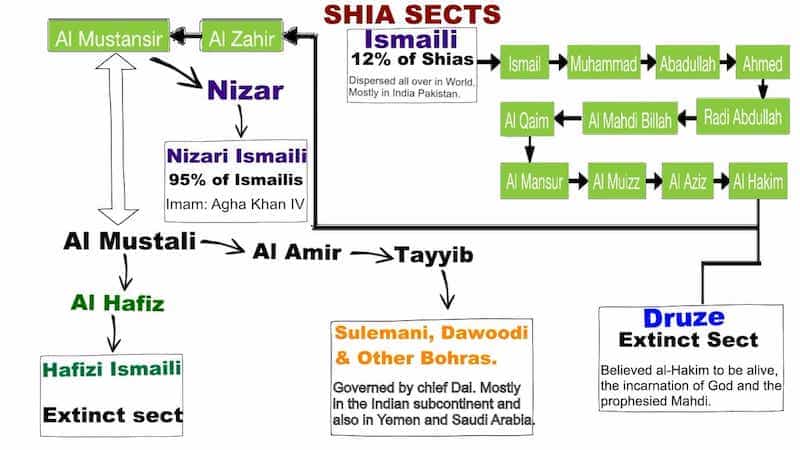
Ismailis separated from the Main Shia group as they accepted Ismail ibn Jafar as their Imam instead of Musa Kazim younger brother of Ismail. History reveals that Ismail actually died before his father Jafar Sadiq. Some Ismaili denies the death of Ismail in the life of his father. The split among them came with the death of Muhammad bin Ismail. The majority denied his death; they recognized him as the Mahdi. They are known as Seveners. The minority believed in his death and would eventually emerge in later times as the Ismaili Fatimid Caliphate, which is also the precursors to all modern Ismaili groups. The secret wisdom of the Ismaili’s was accessible only through a hierarchical organization headed by the imam and was disseminated by Dais missionaries, who introduced believers into the elite through carefully graded levels.
Seveners
I already told you that Seveners are mostly Qarmatians which are now almost extinct. In the second half of the Ninth century in southern Iraq Ismailis Seveners became active under the leadership of Hamdan Qarmat. This branch of the sect is known as the Qaramitah or Qarmatians, established itself in Iraq, Yemen, and especially Bahrain, in the 9th to 11th century.
Fatimid Caliphate: The precursors to all modern Ismaili groups.
Nizari Ismaili
All other Ismaili subgroups emerged from the Imams and Rulers of Fatimid Caliphate. First split occur after 6th Caliph Al-Hakim bi-Amr Allah when in 1021 AD he did not return form a journey and his mule returned soaked in blood. Then his followers did not recognize his successor and they believed al-Hakim to be alive, the incarnation of God and the prophesied Mahdi. Those followers are known as Druze which further split from both Ismailia and Islam. The second split occurred in 1094AD after the death of 8th Fatimid Caliph Maad al-Mustansir Billah. His sons Nizar the older, and Al-Mustali billah the younger, fought for political and spiritual control of the dynasty. Nizar got defeated and Jailed. Then the Egyptians recognized Mustali as Imam and are called Mustali Ismaili and Syrian and Iranian recognize Nizar as Imam and thus called Nizari Ismaili.
Muhammad Shahi Nizari and Qasim-Shahi Nizari

Mustali Ismaili: Hafizi, Tayyebi and Bohras.
Now Mustali Ismaili later moved their religious center to Yemen and they further split into Hafizi and Tayyebi Ismaili. They had not recognized any Fatimid after Al-Mustali’s son al-Amir. Hafizi Ismaili claimed that Al-Amir died without an heir and was succeeded as Caliph and Imam by his cousin Al-Hafiz. The Hafizi Ismaili is also an extinct sect. They had 26 Imams lived in Egypt and Syria but had died out by the 15th century AD. Tayyibi Ismaili are those who believed that after Al Amir death in 1130 AD al-Amir’s infant son al-Ṭayyib their 21st Imam remained alive. They further believe that the line of the imams is hidden until a future time. In the interim, they are governed by the chief Dai. Because Hafizi are extinct so current-day Mustalis are all Tayyibi.
The Tayyibi branch continues to this day, headed by a Dai al-Mutlaq as vice-regent in the imam’s occultation. In 1592, after the death of the 26th Dai Suleman bin Hasan, the grandson of the 24th Dai, was in charge in Yemen and claimed the succession, some accepted and became Sulaymanis Bohras and now are mainly located in Yemen and Saudi Arabia. But the followers of Dawood Bin Qutubshah denied his claim and became the Dawoodi Bohra. Later a split in 1637 from the Dawoodi Bohras resulted in the Alavi Bohra. Dawoodi Bohra, found mostly in the Indian subcontinent and also in Yemen and Saudi Arabia. The name Bohra is a transformation of the Gujarati word vahaurau “to trade.” The Bohra are mostly traders merchants but also has a Sunni Bohra minority who are mainly peasant farmers.
Will come soon!
Will come soon!
Will come soon!



Share this article

Written by : TheLastDialogue
A Synthesis of Religions: The Case of God
Praise belongs to God, the Lord of all realms, the Originator of the heavens and the earth, the One who shaped the human being from clay and breathed into him of His Spirit; the One who sent Messengers, one after another, bearing truth, guidance, and the balance, so that mankind may stand upon justice and not transgress its bounds.
Here is a discourse meant not to conquer but to illuminate, Not to divide but to gather, Not to exalt the writer but to exalt the Word of God. So approach with hearts unburdened, With intellects awakened, With spirits yearning for the Mercy of the All-Merciful. For the earth endures by His command, And knowledge is a trust, And every soul shall be returned to its Lord.
The Last Dialogue (thelastdialogue.org) recognized as a pivotal resource in comparative theology. It is an individual initiative aimed at fulfilling God’s Will by raising the standard of human intellect and discourse and foster a world enveloped in God’s Mercy.
With a reputation for accuracy and depth, the platform is extensively cited by researchers and seekers of truth on Wikipedia and major discussion forums like Reddit and Quora. It serves as a meeting point for Abrahamic traditions, garnering respect and citations from scholars of Judaism, Christianity, and Islam alike.
It distinguishes itself as the sole religious platform adhering to the noble tradition of not soliciting charity, zakat, or donations – a practice aligned with the true Sunnah of Prophets.
قُلْ مَا أَسْأَلُكُمْ عَلَيْهِ مِنْ أَجْرٍ وَمَا أَنَا مِنَ الْمُتَكَلِّفِينَ
Say, "I do not ask you for this any payment, and I am not of the pretentious.