
Book of Corinthians 2 Summary
BIBLE SUMMARY: CORINTHIANS-2
Book of Corinthians-2 Synopsis: Statistics And Summary of Main Topics.
Book of Corinthians-2 Chapter by Chapter Summary.

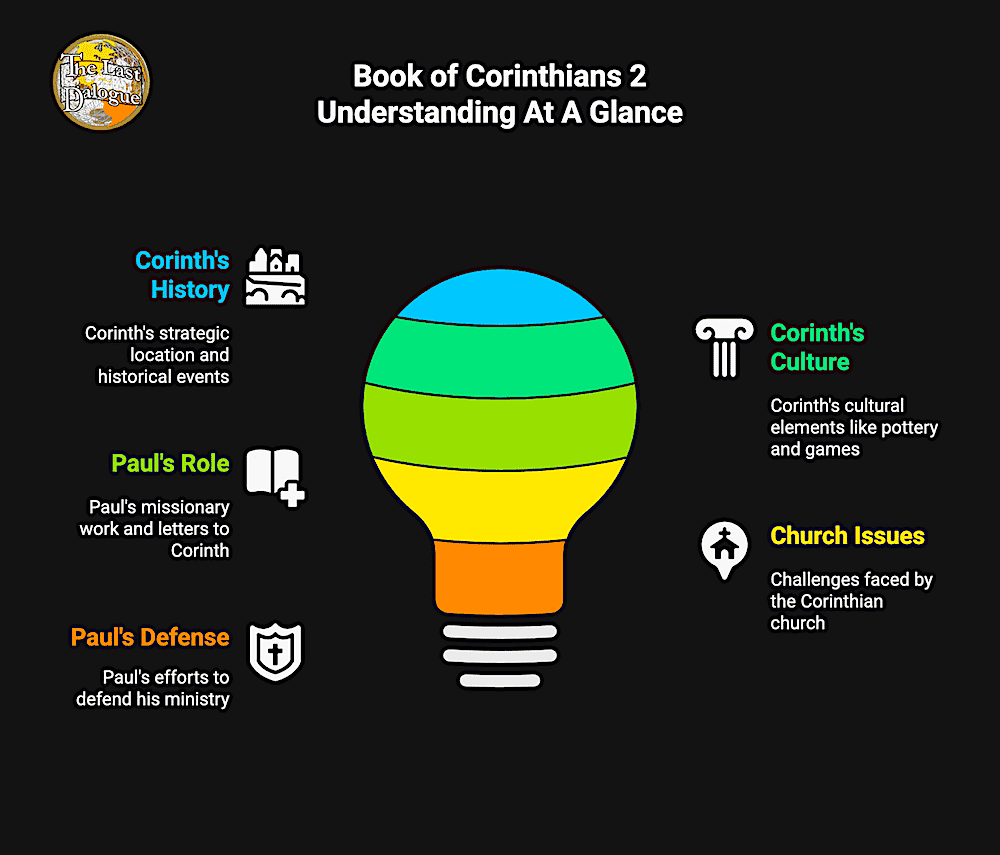
CORINTHIANS-2 TOTAL CHAPTERS: 13
CORINTHIANS-2 TOTAL VERSES: 257
TOTAL WORDS: 6,092
DATE WRITTEN: 57 AD
AUTHOR: Paul
CORINTHIANS-2 THEME:
Paul’s Defense of His Ministry. Divisions and Immorality in the Church. Reminder of the Gospel.
MAJOR CHARACTERS:
Paul, Corinthians.
BOOK OF CORINTHIANS-2 KEY VERSES:
5:17: Therefore, if anyone is in Christ, he is a new creation; the old has gone, the new has come!
5:21: God made him who had no sin to be sin for us, so that in him we might become the righteousness of God.
10:5: We demolish arguments and every pretension that sets itself up against the knowledge of God, and we take captive every thought to make it obedient to Christ.
13:4: For to be sure, he was crucified in weakness, yet he lives by God’s power. Likewise, we are weak in him, yet by God’s power we will live with him to serve you.
CORINTHIANS-2 SUMMARY
Corinth was a shipping harbor and one of the prominent cities of Greece being located very strategically in the region that joins the Peloponnesus to the mainland of Greece. It was sacked by Rome in 146 BC and not restored until 29 BC. It was known for its pottery, brass, games, temples and immoral living. Paul wrote this letter. Paul was one of the church’s earliest preachers and was especially committed to converting the Gentiles. He was not one of the primary twelve apostles and was previously named Saul and had been a devoted Pharisee and oppressed the early Christians. He was converted and designated to his apostleship by direct confrontation with the Christ on the road to Damascus. He established churches all over the Mediterranean world and wrote more NT books than any other writer. All below-mentioned books were written by Paul: Romans, Corinthians 1 & 2, Galatians, Ephesians, Philippians, Colossians 1 & 2, Thessalonians, Timothy, Titus and Philemon. Paul arrived in Corinth around 50 A.D after being in Athens at the end of his second minister journey. Paul lived in the city for a year and a half, the second longest time he spent in any one city. So Paul knew these people well and he was concerned for them. This letter must be dated at least six months to a year after Corinthians-1 was written probably sometime in 56-57 AD. Corinthians-2 was actually Paul’s third or fourth letter to the church at Corinth. His first letters were for a broader corrective message for several problems and misunderstandings in that church. The church had corrected many of the issues which Paul addressed, but their underlying worldliness remained unchanged. There are also people who were preaching a gospel different from Paul’s, and discrediting Paul’s ministry. Corinthians-2 is Paul’s defense of his character and his message to keep the Corinthians from following these false apostles in their heresies.
CHAPTER WISE SUMMARY:
Chapter#1. Paul’s Plan to Come to Corinth. Paul defends his integrity. God Rescued Paul When He Was Suffering. Change in Paul’s travel plans.
Chapter#2. Paul’s intention to bring joy. Immoral Man Cleansed. Reaffirm your love for a penitent sinner. Paul in Troas and Macedonia. A Ministry Of Life Or Death.
Chapter#3. The Glorious Ministry. The ministry of righteousness abounds in glory. Paul’s Competence. The Glory Of The New Covenant
Chapter#4. The Suffering Ministry. Proclaiming Jesus Christ As Lord. We are undergoing temporary affliction. Treasure in earthen vessels
Chapter#5. The Reconciling Ministry. Absent From The Body And At Home With The Lord. The love of Christ controls us.
Chapter#6. The Separated Ministry. Afflictions Of God’s Servants. Open your hearts to believers, not to unbelievers.
Chapter#7. The Heart of Paul. Paul’s Joy At The Corinthians’ Repentance. Titus brings a good report. Sorrow according to God produces repentance.
Chapter#8. Money Matters. Abound in monetary sharing with believers. Arrangements For Administering The Corinthians’ Gift. Titus to be sent to Corinth.
Chapter#9. Cheerful Giving. God loves a cheerful giver.
Chapter#10. Divine Viewpoint vs. Human Viewpoint. Boasting should be in Christ only. Paul defends his ministry.
Chapter#11. Paul Defends His Apostleship. The Boasting of Paul. Paul could have boasted in the flesh. Paul’s hardships as an apostle
Chapter#12. Paul’s visions. The Third Heaven and the Thorn. When I am weak, then I am strong. Paul’s concern for the Corinthians
Chapter#13. Concluding Remarks. Each person should examine himself. Final Greetings And Benediction.



 Book of Corinthians 1 Summary
Share this article

Written by : TheLastDialogue
A Synthesis of Religions: The Case of God
Praise belongs to God, the Lord of all realms, the Originator of the heavens and the earth, the One who shaped the human being from clay and breathed into him of His Spirit; the One who sent Messengers, one after another, bearing truth, guidance, and the balance, so that mankind may stand upon justice and not transgress its bounds.
Here is a discourse meant not to conquer but to illuminate, Not to divide but to gather, Not to exalt the writer but to exalt the Word of God. So approach with hearts unburdened, With intellects awakened, With spirits yearning for the Mercy of the All-Merciful. For the earth endures by His command, And knowledge is a trust, And every soul shall be returned to its Lord.
The Last Dialogue (thelastdialogue.org) recognized as a pivotal resource in comparative theology. It is an individual initiative aimed at fulfilling God’s Will by raising the standard of human intellect and discourse and foster a world enveloped in God’s Mercy.
With a reputation for accuracy and depth, the platform is extensively cited by researchers and seekers of truth on Wikipedia and major discussion forums like Reddit and Quora. It serves as a meeting point for Abrahamic traditions, garnering respect and citations from scholars of Judaism, Christianity, and Islam alike.
It distinguishes itself as the sole religious platform adhering to the noble tradition of not soliciting charity, zakat, or donations – a practice aligned with the true Sunnah of Prophets.
قُلْ مَا أَسْأَلُكُمْ عَلَيْهِ مِنْ أَجْرٍ وَمَا أَنَا مِنَ الْمُتَكَلِّفِينَ
Say, "I do not ask you for this any payment, and I am not of the pretentious.
وَمَآ أَسْـَٔلُكُمْ عَلَيْهِ مِنْ أَجْرٍ ۖ إِنْ أَجْرِىَ إِلَّا عَلَىٰ رَبِّ ٱلْعَـٰلَمِينَ
I do not ask you for any reward for it; my reward is only with the Lord of the worlds.