Surah Al Qamar Summary

NAME: القمر, Al-Qamar.
Name taken from Verse 1 where there is a mention of “Al Qamar”.
١ اقْتَرَبَتِ السَّاعَةُ وَانْشَقَّ الْقَمَرُ
1 The Hour has come near, and the moon has split
But It does not mean that this name is the actual topic discussed in the whole Surah. It is just a reference and mark/symbol to distinguish this Surah from others as is with most other Surahs of Quran. While there are diversified topics discussed in these Surahs.
ENGLISH NAME: The Moon.
CHAPTER NUMBER: 54
SURAH QAMAR TOTAL VERSES: 55
SURAH QAMAR TOTAL WORDS: 342
TOTAL UNIQUE WORDS WITHOUT REPETITION: 231
TOTAL LETTERS: 1,469
REVELATION PERIOD:
Meccan, Approx. 617 – 619 AD.
MAIN CHARACTERS:
God, Prophet Muhammad, Moon, Disbelievers, Nuh/Noah, Ad, Thamud, Salih, She Camel, Lut, Lut’s People, Pharaoh.
SURAH QAMAR MAIN TOPICS:
The Hour Has Come Near And Moon Split Apart, Nuh Story: God Made His Boat A Token, Ad, Destroyed By A Screaming Wind, Thamud Destroyed By One Blast From The Sky, Lut’s people Demanded From Lut His Guests, God Blinded Their Eyes and Destroyed them by A Storm Of Stones.
SURAH QAMAR KEY VERSES:
١ اقْتَرَبَتِ السَّاعَةُ وَانْشَقَّ الْقَمَرُ
1 The Hour has come near, and the moon has split [in two].
٢ وَإِنْ يَرَوْا آيَةً يُعْرِضُوا وَيَقُولُوا سِحْرٌ مُسْتَمِرٌّ
2 And if they see a miracle, they turn away and say, “Passing magic.”
١٣ وَحَمَلْنَاهُ عَلَىٰ ذَاتِ أَلْوَاحٍ وَدُسُرٍ
13 And We carried him on a [construction of] planks and nails,
١٤ تَجْرِي بِأَعْيُنِنَا جَزَاءً لِمَنْ كَانَ كُفِرَ
14 Sailing under Our observation as reward for he who had been denied.
١٥ وَلَقَدْ تَرَكْنَاهَا آيَةً فَهَلْ مِنْ مُدَّكِرٍ
15 And We left it as a sign, so is there any who will remember?
٣٧ وَلَقَدْ رَاوَدُوهُ عَنْ ضَيْفِهِ فَطَمَسْنَا أَعْيُنَهُمْ فَذُوقُوا عَذَابِي وَنُذُرِ
37 And they had demanded from him his guests, but We obliterated their eyes, [saying], “Taste My punishment and warning.”
SUMMARY OF TOPICS
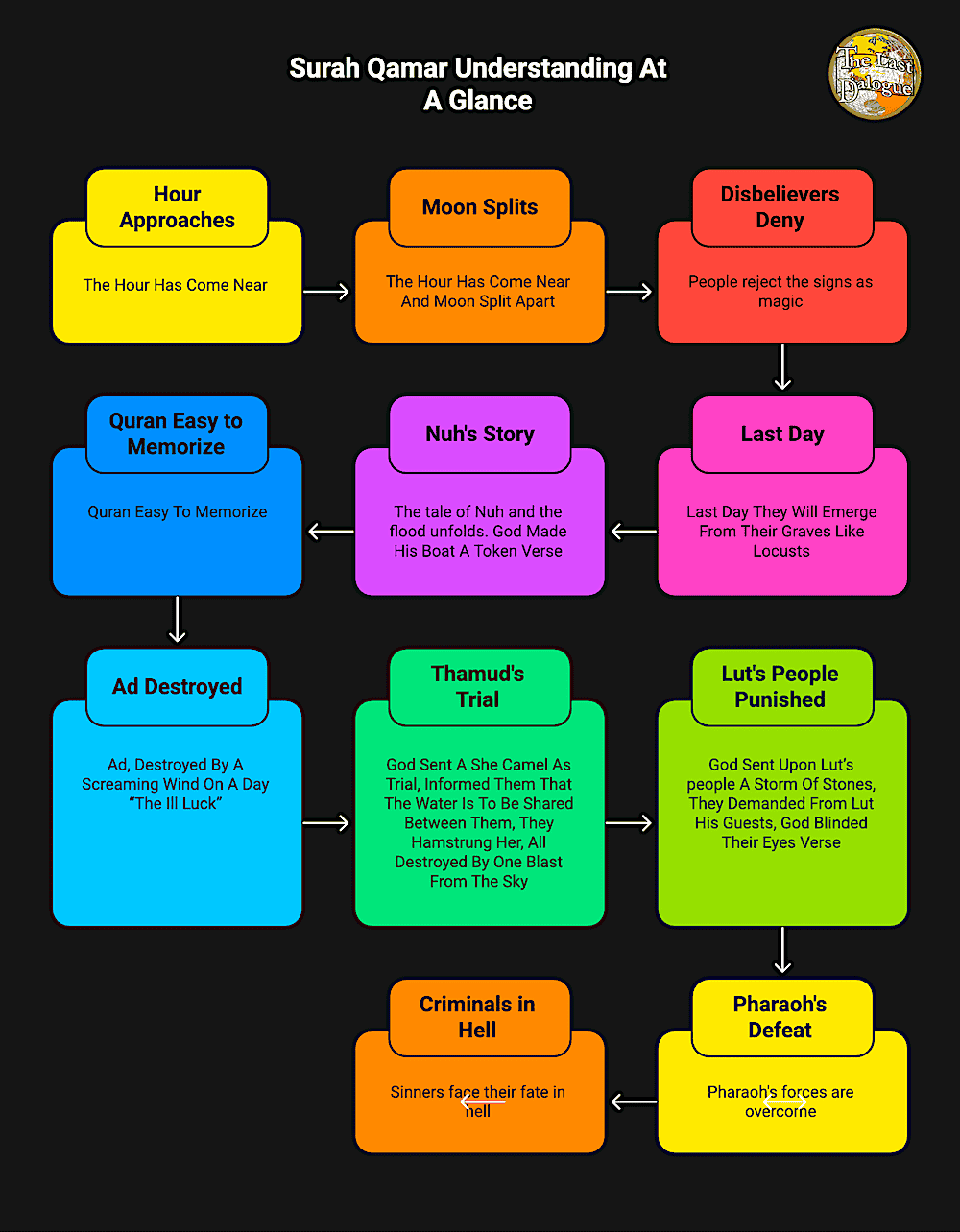
1-5(The Hour Has Come Near And Moon Split Apart, Disbelievers Deny Every Sign And Say Its Magic), 6-8(Last Day They Will Emerge From Their Graves Like Locusts), 9-16(Nuh Story: He Was Denied And Repelled, Then God Opened The Gates Of The Heaven With Rain, Water Met For A Matter Already Predestined, God Made His Boat A Token Verse15), 17(Quran Easy To Memorize), 18-22(Ad, Destroyed By A Screaming Wind On A Day “The Ill Luck”), 23-31 (Thamud, Prophet Salih, God Sent A She Camel As Trial, Informed Them That The Water Is To Be Shared Between Them, They Hamstrung Her, All Destroyed By One Blast From The Sky), 33-39(Prophet Lut: God Sent Upon Lut’s people A Storm Of Stones, They Demanded From Lut His Guests, God Blinded Their Eyes Verse37, Punishment By Morning), 41-42(Pharaoh), 45(Prediction Of Defeat of Disbelievers In The World And Hereafter), 49-55(Criminals In Hell, Everything God Created By Measure, God’s Command Is Like Twinkling Of Eye, Every Small And Great Thing Is Inscribed)
SURAH QAMAR BRIEF COMMENTARY & BACK GROUND:
This Surah has 55 verses divided into 3 Rukus/Sections. It takes its name from verse 1: اقْتَرَبَتِ السَّاعَةُ وَانْشَقَّ الْقَمَرُ. As discussed above, the name is only a reference and not the topic of the Surah. This Surah was revealed in Mecca in the middle period of Muhammad’s prophethood. As per various traditions verse 1 considered as pointing to a miracle revealed to Meccans thru Prophet Muhammad in which he showed the moon split in two in response to a challenge to present some divine proof of his prophethood from his opponents. Commentators are agreed that this event took place at Mina in Mecca about 5 years before Prophet’s migration to Madina.
The Surah talks about the impending Day of Judgment. It outlines some of the scenes of that Day. It also tells that God’s decision may come here and now. The stories of the people of Ad, Thamud, Noah, Lot, and Pharaoh told to show that how they denied the divine message and truth and in turn invoked God’s wrath.
Abu Waqid narrated a hadith that the Prophet of God used to recite Surah Qaf and Qamar during significant gatherings and events because they contain promises of God and warnings, and also the knowledge and information about the origin of creation, life after death and oneness of God.

Share this article

Written by : TheLastDialogue
A Synthesis of Religions: The Case of God
Praise belongs to God, the Lord of all realms, the Originator of the heavens and the earth, the One who shaped the human being from clay and breathed into him of His Spirit; the One who sent Messengers, one after another, bearing truth, guidance, and the balance, so that mankind may stand upon justice and not transgress its bounds.
Here is a discourse meant not to conquer but to illuminate, Not to divide but to gather, Not to exalt the writer but to exalt the Word of God. So approach with hearts unburdened, With intellects awakened, With spirits yearning for the Mercy of the All-Merciful. For the earth endures by His command, And knowledge is a trust, And every soul shall be returned to its Lord.
The Last Dialogue (thelastdialogue.org) recognized as a pivotal resource in comparative theology. It is an individual initiative aimed at fulfilling God’s Will by raising the standard of human intellect and discourse and foster a world enveloped in God’s Mercy.
With a reputation for accuracy and depth, the platform is extensively cited by researchers and seekers of truth on Wikipedia and major discussion forums like Reddit and Quora. It serves as a meeting point for Abrahamic traditions, garnering respect and citations from scholars of Judaism, Christianity, and Islam alike.
It distinguishes itself as the sole religious platform adhering to the noble tradition of not soliciting charity, zakat, or donations – a practice aligned with the true Sunnah of Prophets.
قُلْ مَا أَسْأَلُكُمْ عَلَيْهِ مِنْ أَجْرٍ وَمَا أَنَا مِنَ الْمُتَكَلِّفِينَ
Say, "I do not ask you for this any payment, and I am not of the pretentious.