Quran On 10 Habits of People With Extremely High IQ
Table Of Contents
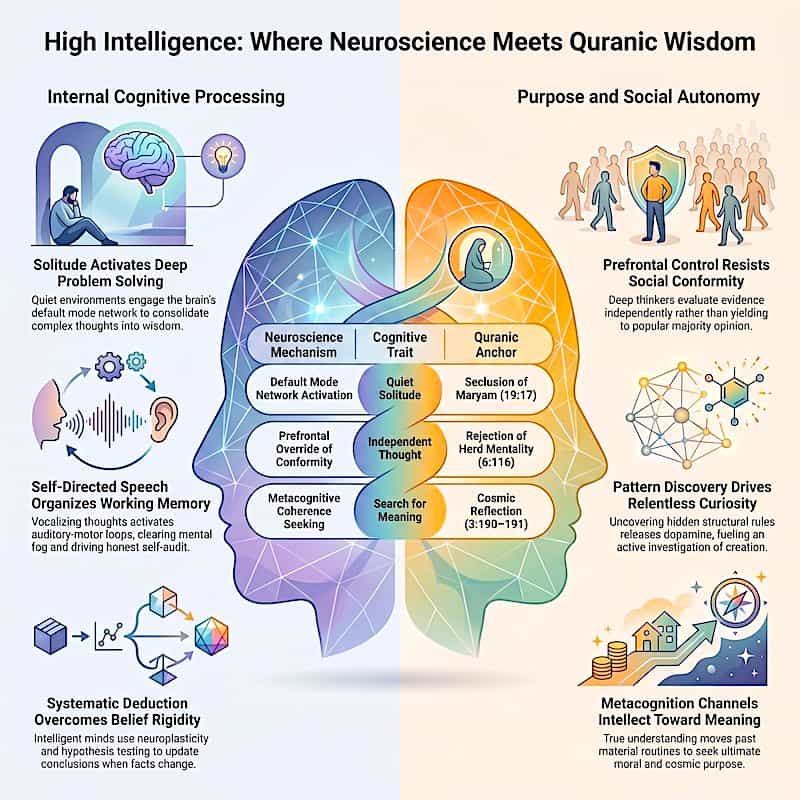
- 1. Solitude: Why Deep Minds Need Quiet Space
- 2. Relentless Curiosity and Pattern Recognition
- 3. Self-Directed Speech: How the Brain Organizes Working Memory
- 4. Overthinking: Running Multi-Step Brain Simulations
- 5. Subtle Humor: How the Brain Connects Unrelated Ideas
- 6. Cognitive Flexibility: Updating the Mind When Evidence Changes
- 7. Systematic Deductive Reasoning: Testing Every Claim Before Believing
- 8. Late-Night Mental Clarity: Why the Brain Focuses in the Dark
- 9. Independent Thinking: Resisting Blind Social Conformity
- 10. The Deep Search for Meaning: Why High Intelligence Craves Purpose
- Deep Thinking in a Fast, Distracted World
- Frequently Asked Questions
- 1. Who are the Ulul-Albab mentioned in the Quran?
- 2. Why do people with high IQs often prefer solitude?
- 3. How does the Quran encourage scientific inquiry and pattern recognition?
- 4. What is the difference between overthinking and Quranic reflection?
- 5. How did Prophet Ibrahim demonstrate deductive hypothesis testing?
- Frequently Asked Questions
🎬 Watch The Cinematic Video 🎬
⚠️ Warning: This Will Open In Youtube
Coming Soon
Most people assume that an exceptionally smart person will automatically become wealthy, famous, highly successful, and surrounded by followers. But intelligence and outward success are not the same thing, and real life reveals a much more complicated relationship between the two.
Popular Perception of High Intelligence
Popular culture often portrays highly intelligent people as individuals who naturally achieve extraordinary success—earning more money, gaining fame, building massive followings, and rising quickly to positions of power and influence.
The Reality of Deep Minds
Truly brilliant thinkers do not always chase money, fame, status, or massive success. They are often quiet, deeply reflective, and intensely observant, spending hours alone investigating hidden patterns and questioning how the world works. Their intelligence may show itself less in outward wealth, popularity, or the number of followers they have—and more in the depth of their thinking, curiosity, and understanding.
The Quranic Perspective: Ulul-Albab
Long before modern laboratories mapped human brain circuits, the Quran identified this distinct group of thinkers. It calls them Ulul-Albab (أُولُو الْأَلْبَابِ)—the people of deep intellect and pure understanding.
The Quran does not treat high intelligence as cheap cleverness or arrogant pride. Instead, it describes an active inner mind that reads the signs of the universe, seeks purpose, and stays grounded in truth.
Here are 10 key habits that reveal the psychology of exceptionally intelligent minds.
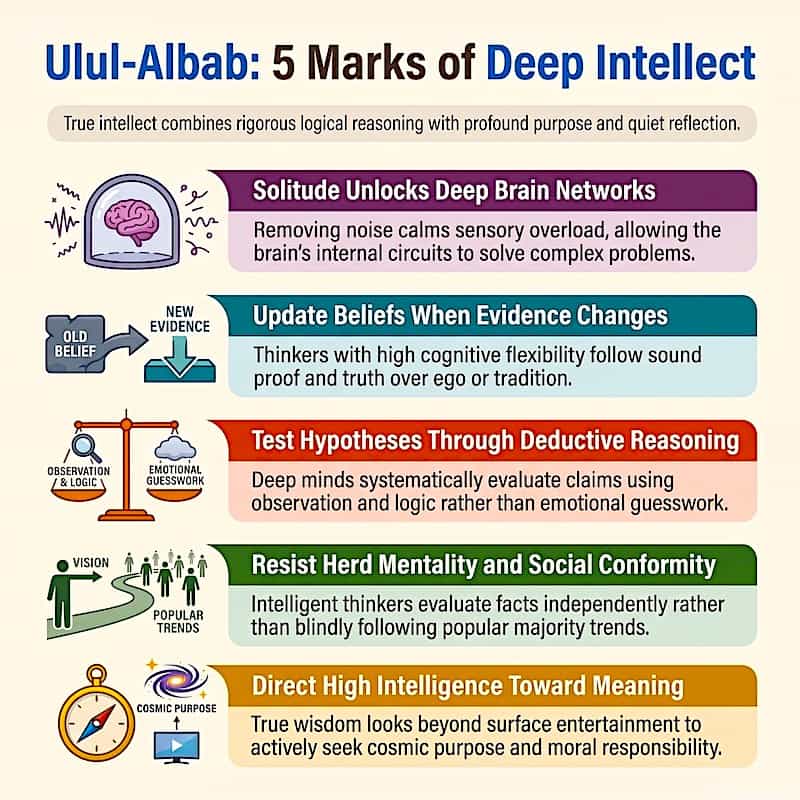
1. Solitude: Why Deep Minds Need Quiet Space
Many people assume that someone who spends time alone is lonely or antisocial. Neuroscience shows that the opposite is often true.
The front part of the human brain is called the prefrontal cortex. It handles executive planning, abstract thinking, and deep reflection. When you are surrounded by noise and constant chatter, your brain burns energy just filtering out distractions.
Modern brain scans show that when external noise stops, the brain switches on its default mode network. This quiet internal circuit weaves memories together, links distant ideas, and solves difficult problems.
The Quran presents quiet seclusion as a powerful tool for mental clarity. True thinkers regularly step back from the crowd to let their minds process what matters most.
We see this quiet retreat in the life of Maryam (Mary), peace be upon her, who stepped away from social distractions to reflect and pray in peace:
Quiet time is not wasted time. For a strong mind, solitude is the mental workshop where raw thoughts turn into real wisdom.
2. Relentless Curiosity and Pattern Recognition
People with high intelligence do not just memorize facts. Their brains naturally search for the hidden rules that connect things together.
Neuroscience explains that when your brain spots an unexpected connection or solves a puzzle, it releases dopamine. This chemical makes pattern-seeking feel deeply satisfying. A high-IQ brain is wired to keep chasing that spark of discovery.
The Quran continuously calls for this exact type of active, pattern-seeking curiosity. It urges people to look closely at nature, biology, and human life to uncover how things actually function:
Curiosity is the fuel of real intellect. When you observe the world with an open mind, every detail reveals an orderly design.
3. Self-Directed Speech: How the Brain Organizes Working Memory
Have you ever caught someone quietly talking to themselves while working on a complex problem? People sometimes make fun of this habit, but cognitive scientists consider it a sign of high executive function.
Psychologists call this self-directed speech. Speaking your thoughts out loud activates both motor and auditory pathways in the brain. This two-way loop strengthens your working memory buffer, helping you keep track of multiple steps without losing focus.
The Quran connects this inner vocalization with muhasabah, the habit of honest self-dialogue. A wise person does not drift through life unexamined; they talk directly to their inner self (an-nafs) to evaluate their choices:
A brilliant mind talks to itself to clear away mental fog, organize ideas, and keep its motives honest.
4. Overthinking: Running Multi-Step Brain Simulations
An analytical brain rarely sits idle. Highly intelligent individuals often evaluate simple conversations, everyday plans, and future risks from many different angles.
To outsiders, this can look like hesitation or indecision. Inside the brain, however, something remarkable is happening. The brain’s planning centers are running branching simulations to test every possible outcome before making a move.
The Quran channels this analytical power into purposeful reflection, known as tadabbur (weighing long-term outcomes) and tafakkur (careful observation). It reminds us that no choice in life is too small to consider:
When a thoughtful person understands that every tiny action carries weight, careful analysis replaces reckless speed.
5. Subtle Humor: How the Brain Connects Unrelated Ideas
Research in cognitive psychology shows a clear link between high intelligence and advanced humor processing. Understanding a sharp, subtle joke requires your brain to process multiple meanings at once.
Neuroscientists describe this as incongruity resolution. The brain predicts what should happen, notices an unexpected twist, and quickly links two distant concepts together to make sense of the punchline.
However, there is a clear divide between cruel mockery and wholesome wit.
Wholesome Wit & Cognitive Agility
Connects unexpected realities, uplifts the spirit, and reveals life’s gentle ironies while remaining strictly grounded in honesty, kindness, and empathy.
Cruel Mockery & Sarcasm
Relies on demeaning others, humiliating targets for cheap laughter, and disguising arrogance as cleverness—a distortion that deep intellect actively rejects.
The Prophetic tradition shows that true intellect uses humor gently and never builds amusement on falsehood. The Prophet Muhammad (peace be upon him) smiled often, joked with his companions, but never spoke an untruth. High intelligence notices life’s surprising ironies without turning arrogant or harmful.
6. Cognitive Flexibility: Updating the Mind When Evidence Changes
Mental rigidity is often mistaken for confidence, but it is usually a sign of an insecure mind. Truly intelligent people treat their personal beliefs as working models that update whenever better facts appear.
In brain science, this is called cognitive flexibility. It depends on neuroplasticity—the brain’s ability to prune away outdated assumptions and build new neural circuits when fresh data arrives.
The Quran praises this open-minded, truth-seeking attitude. It describes the people of true understanding as those who listen carefully to different arguments and choose the soundest path:
A wise mind loves the truth more than its own ego. When clear proof arrives, an intelligent person updates their understanding without hesitation.
7. Systematic Deductive Reasoning: Testing Every Claim Before Believing
People with high intelligence do not accept claims just because the crowd believes them. Their minds demand clear proof, testing assertions step-by-step through logical deduction.
In cognitive science, this is known as hypothesis testing. The thinker sets up a clear rule: if a theory is true, its consequences must hold up under observation. If the evidence contradicts the theory, the theory must be thrown out.
The Quran gives a timeless masterclass in this exact deductive method through the story of Prophet Ibrahim (Abraham), peace be upon him. When searching for the true Creator, he refused to follow the blind traditions of his society. Instead, he systematically tested every candidate using observation and deduction.
First, he examined a bright star in the night sky:
Prophet Ibrahim’s Deductive Process
Observing the Setting Star
Examining the Glowing Moon
Evaluating the Radiant Sun
Next, he applied the exact same test to the glowing moon, and then to the radiant sun. Each time the celestial body set beneath the horizon, his logical deduction was undeniable: a created object that fades, moves, and disappears cannot be the eternal sustainer of existence.
Ibrahim did not rely on emotional guesswork. He tested every hypothesis, dismantled false assumptions, and followed the evidence straight to the truth.
8. Late-Night Mental Clarity: Why the Brain Focuses in the Dark
Many high-IQ individuals find that their sharpest thinking happens late at night. During nighttime hours, natural ambient light drops and social demands fade away.
Chronobiology research shows that late-night thinkers often have different circadian rhythms. Without daytime visual clutter and message notifications competing for attention, the brain’s sensory cortex calms down. This leaves maximum processing bandwidth for creative problem-solving.
The Quran highlighted this unique nighttime focus more than fourteen centuries ago:
During the night, your thoughts and feelings lock into step. The stillness gives the brain the unbroken focus that deep thinkers need.
9. Independent Thinking: Resisting Blind Social Conformity
A major discovery in social psychology is that crowds often force people into false agreement. When people are surrounded by a confident majority, fear circuits in the brain activate, pressuring them to conform even when the group is clearly wrong.
People with high intelligence show stronger prefrontal control. They do not accept an idea simply because it is popular or trending. They evaluate facts independently, even if it means standing completely alone.
The Quran constantly warns against the herd mentality. It reminds us that numbers do not define truth:
Real intellect gives you the courage to think for yourself. A deep mind follows evidence, not popular trends.
10. The Deep Search for Meaning: Why High Intelligence Craves Purpose
The single most defining trait of deep intelligence is an insatiable search for meaning. Shallow routines, surface-level entertainment, and material wealth cannot satisfy a genuinely thoughtful mind.
Highly intelligent people constantly ask big questions: Why are we here? Why does the universe have order? What is the purpose of my life?
In modern psychology, this is recognized as metacognition—the unique human ability to step back, examine our own consciousness, and seek ultimate coherence.
The Quran brings all these traits together in one unforgettable portrait of Ulul-Albab:
The Harmonized Mind of Ulul-Albab
Cosmic Contemplation (Tafakkur)
Continuous Mindfulness (Dhikr)
The Realization of Purpose
Moral and Spiritual Awakening
Summary Table: 10 Signs of High Intelligence in Neuroscience and the Quran
| Sign / Habit | Brain & Cognitive Mechanism | Quranic Anchor | Practical Takeaway |
|---|---|---|---|
| 1. Quiet Solitude | Default mode network engages; sensory filtering load drops | Seclusion of Maryam (Surah Maryam 19:17) | Protect quiet time daily to let your brain connect complex ideas. |
| 2. Relentless Curiosity | Dopamine release rewards pattern discovery | Signs across nature (Surah Al-Ghashiyah 88:17–20) | Pay attention to small details; every system reveals order. |
| 3. Self-Directed Speech | Auditory-motor loop stabilizes working memory | Self-auditing soul (Surah Al-Qiyamah 75:2) | Talk through hard problems out loud to clear mental fog. |
| 4. Deep Overthinking | Frontal cortex runs branching scenario simulations | Counting every atom (Surah Az-Zalzalah 99:7–8) | Channel intense thinking into long-term planning, not worry. |
| 5. Subtle Humor | Incongruity resolution links distant brain networks | Prophetic joyful wit without untruth (Sunnah) | Appreciate ironies of life without resorting to cruelty or lies. |
| 6. Cognitive Flexibility | Neuroplasticity prunes old assumptions for new data | Following the best speech (Surah Az-Zumar 39:18) | Update your views immediately when sound evidence appears. |
| 7. Deductive Reasoning | Step-by-step hypothesis testing | Ibrahim’s celestial inquiry (Surah Al-An’am 6:76–79) | Test claims with observation and logic rather than guessing. |
| 8. Late-Night Clarity | Calmer sensory cortex frees executive bandwidth | Hours of the night (Surah Al-Muzzammil 73:6) | Use quiet late hours for deep study and focused reflection. |
| 9. Independent Thinking | Prefrontal control overrides social conformity anxiety | Rejecting herd mentality (Surah Al-An’am 6:116) | Base your choices on clear truth, not on what is popular. |
| 10. Search for Meaning | Metacognitive awareness seeks ultimate coherence | Ulul-Albab cosmic reflection (Surah Ali ‘Imran 3:190–191) | Direct your intellect toward ultimate moral and spiritual purpose. |
Deep Thinking in a Fast, Distracted World
Today, we live in a world filled with short video clips, instant notifications, and automated answers. Quick information is everywhere, but slow, patient reflection is disappearing.
A computer can calculate millions of numbers in a second, but it cannot feel moral responsibility, exercise genuine self-control, or discover spiritual meaning.
A Closing Reflection: Intellect as a Sacred Trust
The Quran teaches that a powerful intellect is not a trophy to show off. It is a serious trust. When sharp thinking unites with a sincere heart, curiosity turns into wisdom, and understanding becomes a lifelong journey toward the Creator.
Frequently Asked Questions
1. Who are the Ulul-Albab mentioned in the Quran?
In the Quran, Ulul-Albab refers to “people of profound understanding and pure intellect.” Rather than viewing intelligence merely as verbal cleverness or argumentative skill, the Quran describes them as deeply reflective individuals who contemplate natural phenomena, seek moral truth, and recognize divine purpose behind cosmic design.
2. Why do people with high IQs often prefer solitude?
Neuroscience shows that solitude allows the brain to engage its default mode network, which integrates distant memories and solves complex problems without sensory distractions. The Quran mirrors this need for mental clarity through the examples of righteous figures like Maryam, who stepped away from social chatter into quiet seclusion to reflect and pray.
3. How does the Quran encourage scientific inquiry and pattern recognition?
The Quran repeatedly commands humans to observe biological, meteorological, and geological patterns (such as in Surah Al-Ghashiyah 88:17–20). This systematic observation aligns directly with cognitive neuroscience, which shows that identifying hidden connections triggers dopamine and fuels intellectual drive.
4. What is the difference between overthinking and Quranic reflection?
While unstructured overthinking can spiral into anxiety, the Quran channels analytical scenario simulation into purposeful reflection (tadabbur and tafakkur). Recognizing that every small action carries eternal weight replaces unproductive worry with methodical, forward-looking intentionality.
5. How did Prophet Ibrahim demonstrate deductive hypothesis testing?
Prophet Ibrahim (peace be upon him) utilized a classic deductive method by systematically testing candidates for divinity—first a star, then the moon, and finally the sun. Upon observing that each celestial body inevitably sets and fades, he deduced that transient, dependent objects cannot be the eternal Sustainer of the cosmos.
📚 Must Read Articles 📚


Share this article

Written by : The Last Dialogue
A Synthesis of Religions: The Case of God
Praise belongs to God, the Lord of all realms, the Originator of the heavens and the earth, the One who shaped the human being from clay and breathed into him of His Spirit; the One who sent Messengers, one after another, bearing truth, guidance, and the balance, so that mankind may stand upon justice and not transgress its bounds.
Here is a discourse meant not to conquer but to illuminate, Not to divide but to gather, Not to exalt the writer but to exalt the Word of God. So approach with hearts unburdened, With intellects awakened, With spirits yearning for the Mercy of the All-Merciful. For the earth endures by His command, And knowledge is a trust, And every soul shall be returned to its Lord.
The Last Dialogue (thelastdialogue.org) recognized as a pivotal resource in comparative theology. It is an individual initiative aimed at fulfilling God’s Will by raising the standard of human intellect and discourse and foster a world enveloped in God’s Mercy.
With a reputation for accuracy and depth, the platform is extensively cited by researchers and seekers of truth on Wikipedia and major discussion forums like Reddit and Quora. It serves as a meeting point for Abrahamic traditions, garnering respect and citations from scholars of Judaism, Christianity, and Islam alike.
It distinguishes itself as the sole religious platform adhering to the noble tradition of not soliciting charity, zakat, or donations – a practice aligned with the true Sunnah of Prophets.
قُلْ مَا أَسْأَلُكُمْ عَلَيْهِ مِنْ أَجْرٍ وَمَا أَنَا مِنَ الْمُتَكَلِّفِينَ
Say, "I do not ask you for this any payment, and I am not of the pretentious.
وَمَآ أَسْـَٔلُكُمْ عَلَيْهِ مِنْ أَجْرٍ ۖ إِنْ أَجْرِىَ إِلَّا عَلَىٰ رَبِّ ٱلْعَـٰلَمِينَ
I do not ask you for any reward for it; my reward is only with the Lord of the worlds.